
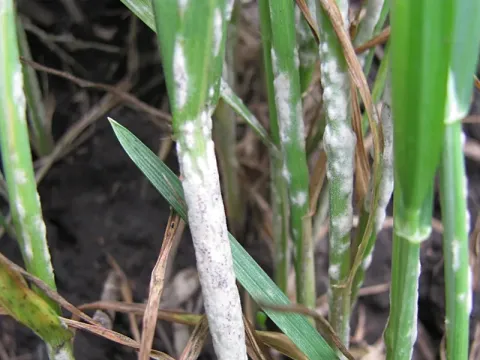
Powdery mildew of cereals
Erysiphe graminis
Powdery mildew is caused by the obligate parasite Erysiphe graminis. This fungus is a specialized pathogen that completes its life cycle only on living plant tissues.
What the section contains
Powdery mildew of cereals
The fungus develops a superficial mycelium on the surface of plant organs. It anchors itself to the epidermis using haustoria, which penetrate the cells to absorb nutrients.
The disease spreads primarily through asexual spores called conidia, which form the characteristic white powdery mass. Later in the season, sexual fruiting bodies, known as cleistothecia, appear as small black dots.
The pathogen is highly host-specific, with distinct forms (forma specialis) affecting specific cereal species like wheat, barley, and oats.
Taxonomically, it belongs to the order Erysiphales within the phylum Ascomycota. It is recognized as one of the most persistent and widespread diseases in global cereal production.
The disease attacks all above-ground parts of the plant, including leaves, stems, and leaf sheaths. In severe cases, the infection can spread to the spikelets.
By covering the leaf surface, the fungus significantly reduces photosynthetic efficiency. This leads to weakened plants, reduced tillering, and stunted overall growth.
Infection during the grain-filling stage results in shriveled grains and lower test weight. This directly impacts both the total yield volume and the milling quality of the harvest.
Yield losses can range from 10% to 50% depending on the severity and timing of the infection. Plants affected early in the season are particularly vulnerable to secondary environmental stresses.
Beyond yield loss, powdery mildew weakens the plant's structural integrity, increasing the risk of lodging, which complicates harvesting operations and further damages crop quality.
Powdery mildew development is favored by temperatures between 15°C and 22°C and high relative humidity. It often appears first on winter crops during the early spring.
Conidia are easily disseminated by wind across long distances. Under optimal conditions, the pathogen can produce multiple infection cycles in a single growing season.
Dense canopies, high nitrogen fertilization, and lack of airflow create a microclimate that promotes rapid disease progression across the entire field.
While extremely hot and dry weather may slow down the development of the fungus, persistent humidity within the lower canopy allows the infection to survive and spread.
The fungus overwinters as mycelium on volunteer crops or as cleistothecia on infected crop residues, which serve as the primary inoculum for the next spring season.
The most distinctive sign is the appearance of white, fuzzy, cotton-like patches on the leaves. These patches look like a dusting of flour or powder.
As the infection progresses, these spots coalesce and may turn greyish or light brown. Eventually, small black, pin-head-sized fruiting bodies form within the mycelium.
- Yellowing of leaf tissue beneath the fungal colonies.
- Deformation and premature senescence of the affected leaves.
- Reduced vigor and delayed development of the grain-bearing spikes.
- Fungal growth that can be easily wiped away by touch.
Early identification is essential. Inspections should focus on the lower leaves in early spring, as this is where the primary infection usually starts before spreading upwards.
Integrated pest management strategies include crop rotation to break the life cycle of the fungus and thorough incorporation of crop residues into the soil.
The use of resistant cultivars is the primary defense method. Breeding programs continuously work to incorporate new resistance genes to manage evolving fungal strains.
Fungicide application is recommended when economic thresholds are met. Effective chemical groups include triazoles, strobilurins, and morpholines, which provide systemic protection.
Seed treatments with systemic fungicides help protect young seedlings from early-season infection, allowing the crop to establish a strong root and leaf system.
Balanced fertilization and optimal seeding rates are crucial cultural practices. Avoiding excessive nitrogen application reduces the density of the canopy and lowers susceptibility.