
Powdery mildew
Oidium
Description
How to identify
Powdery mildew is a destructive fungal disease affecting grapevines, caused by the obligate parasite Erysiphe necator. It is one of the most significant pathogens in viticulture worldwide.
The fungus develops primarily on the surface of green plant tissues, producing a mycelium network that anchors itself into epidermal cells using haustoria to extract nutrients.
Taxonomically, the pathogen belongs to the family Erysiphaceae. Its ability to reproduce rapidly via conidia (asexual spores) allows it to spread widely throughout the growing season.
Overwintering occurs either as mycelium within dormant buds or as chasmothecia (formerly cleistothecia) that persist on the bark of vines and fallen leaf litter.
Unlike many other fungi, Erysiphe necator does not require free water on the leaf surface to germinate, which makes it highly successful in various climates.
What it damages
This pathogen targets all green parts of the grapevine, including leaves, shoots, inflorescences, and berries. It significantly reduces the photosynthetic capacity of the plant.
The most devastating damage occurs on the berries. If the skin is infected during the early growth stage, the berry will split as it expands, leaving it susceptible to rot and secondary infections.
Infection of the inflorescences often results in flower drop and a complete loss of fruit yield. The cumulative effect of the disease is a reduction in vine vigor and wood maturity.
Badly infected shoots may show necrotic spots, and the overall plant health declines, making the vines more susceptible to cold injury and pests.
Economic losses are significant due to direct crop loss and the high costs associated with repeated fungicide applications required for control.
When it appears
Infection cycles begin in the spring when temperatures rise above 15°C (59°F). The disease thrives in warm, dry weather conditions.
The fungus is most active at temperatures between 20°C and 27°C (68°F–81°F). High humidity, even without rain, provides an ideal environment for spore germination.
Spore dispersal is primarily wind-driven. During the peak summer months, the disease can spread rapidly through a vineyard if canopy management is insufficient.
Reduced light and poor air circulation in dense canopies provide an ideal microclimate for the pathogen to flourish, leading to severe outbreaks.
Extreme temperatures above 35°C (95°F) can slow down the development of the fungus, but generally do not kill the established mycelium.
Signs of infestation
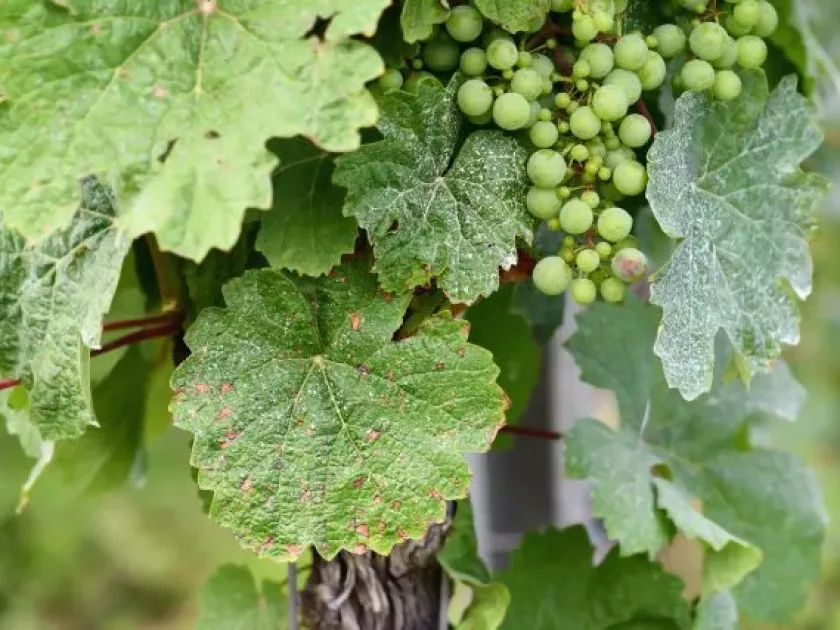
The most recognizable sign is a grayish-white, powdery fungal growth that covers the surface of leaves, shoots, and berries.
Leaves may become distorted, curled, or stunted as the fungus disrupts normal cell growth. Chlorotic or yellow spots may appear on leaves before the white mycelium becomes visible.
Berries infected after they have reached a certain sugar level may show a net-like scarring pattern on the skin rather than the typical white powdery coating.
A distinctive, musty odor is often detected in vineyards with high disease pressure, especially during hot, humid days.
- White, powdery film on foliage.
- Leaf curling and deformation.
- Flower shriveling and abortion.
- Berry splitting and necrosis.
Control measures
Cultural practices such as leaf thinning, shoot positioning, and timely canopy management are essential to improve air circulation and sunlight penetration.
Chemical control involves the use of systemic and contact fungicides, particularly during the critical windows of pre-bloom and fruit set.
Sulfur-based fungicides have been a traditional and highly effective tool for managing powdery mildew when applied preventatively.
To avoid the development of fungicide resistance in Erysiphe necator, growers must rotate products with different modes of action throughout the season.
Monitoring for initial symptoms is crucial. Integrated Pest Management (IPM) strategies, including biological control agents, help maintain vineyard health while reducing chemical impact.
Causes diseases · 2
Discussion
No discussions yet — be the first.