
Powdery mildew of cucurbits
Podosphaera xanthii
Description
How to identify
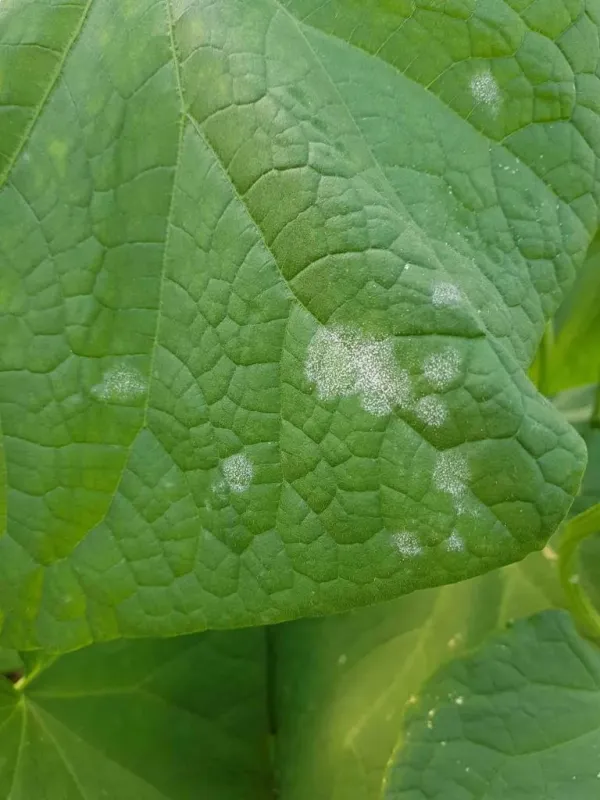
The causative agent of this disease is the obligate parasitic fungus Podosphaera xanthii, a member of the Ascomycota phylum. It is a microscopic pathogen that develops primarily on the surface of plant organs, creating a distinct white powdery appearance.
The fungus's life cycle involves asexual reproduction via conidia, which are easily wind-dispersed, and sexual reproduction through the formation of cleistothecia, which allow the pathogen to overwinter on plant debris.
This pathogen is highly specialized, specifically targeting plants in the Cucurbitaceae family. It extracts nutrients from the host's epidermal cells using specialized structures called haustoria, which significantly weakens the plant.
Optimal conditions for spore germination include moderate temperatures (20–25°C) and high humidity; however, conidia dispersal is often triggered by fluctuations in humidity or the presence of dew.
The disease is widespread across the globe in both open fields and protected environments, acting as a major limiting factor for cucurbit crop production.
What it damages
Powdery mildew affects a wide range of important crops, including cucumber, squash, pumpkin, zucchini, watermelon, and melon. It can infect all above-ground plant parts, including leaves, petioles, and stems.
In cases of severe infestation, the fungal mycelium can also cover the fruit, which significantly reduces their market value, visual quality, and shelf life.
The most devastating impact occurs during early plant development, where the pathogen severely restricts growth and causes premature senescence of the foliage.
The loss of the leaf canopy drastically reduces photosynthetic activity, leading to substantial yield losses that can exceed 30–50% in severe epidemic years.
Furthermore, plants weakened by powdery mildew become significantly more susceptible to secondary infections, including root rots and various bacterial diseases.
When it appears
Primary infection sources appear early in the season when spores are transported from weed hosts or overwintered crop residues onto young seedlings.
Peak disease pressure typically occurs in the mid-to-late season when daily temperature fluctuations promote dew formation on leaf surfaces.
In greenhouses, the pathogen can complete its cycle continuously throughout the year, meaning outbreaks can occur at any time if microclimate conditions are not strictly managed.
High plant density and poor air circulation in indoor facilities act as major contributors to the rapid spread of conidia across the crop.
Prolonged dry periods interspersed with cooler nights provide the perfect environmental backdrop for widespread epidemics in field-grown crops.
Signs of infestation
The initial symptom is the appearance of small, isolated white powdery spots on the upper leaf surfaces, which expand rapidly into larger patches.
As the infection progresses, the spots coalesce, eventually covering the entire surface of leaves, stems, and petioles with a thick, white, flour-like mycelial layer.
Beneath the fungal layer, the plant tissue begins to turn chlorotic, eventually turning brown and dying, which results in the plant looking prematurely aged.
During the late stages of infection, tiny black dots known as cleistothecia appear within the white mycelium, marking the fungus's preparation for dormancy.
- White powdery spots on leaves.
- Yellowing and chlorosis under the mycelial layer.
- Leaf curling and deformation.
- Premature drying and shedding of foliage.
- Appearance of black dots on mature mycelium.
Control measures
Integrated pest management begins with crop rotation, ensuring that cucurbits are not planted in the same field for at least 3–4 years to break the infection cycle.
Rigorous sanitation practices, such as removing weeds and deeply incorporating plant residues into the soil, are essential to eliminate primary inoculum sources.
In greenhouse settings, maintaining proper humidity and temperature control is crucial to minimize the conditions that favor fungal growth.
Chemical control involves the use of systemic and contact fungicides, such as triazoles, strobilurins, or sulfur-based products, which effectively inhibit mycelial development.
It is vital to rotate fungicides with different modes of action to prevent the development of resistance in Podosphaera xanthii populations.
Causes diseases · 1
Discussion
No discussions yet — be the first.