
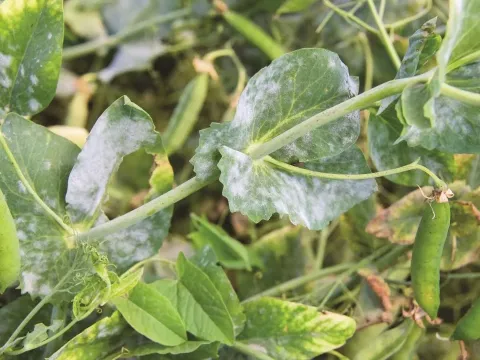
Powdery mildew of pea
Erysiphe pisi
The causative agent of pea powdery mildew is the fungus Erysiphe pisi, an obligate biotrophic parasite. It belongs to the Ascomycota division and survives between seasons either as mycelium on crop residues or as dormant cleistothecia.
What the section contains
Powdery mildew of pea
The infection begins when airborne conidia land on susceptible pea tissues. Once the spores germinate, the fungus develops a network of superficial hyphae, forming the characteristic white, powdery patches that give the disease its name.
The pathogen thrives in warm, dry weather conditions, although it can propagate rapidly in humid environments. The production of conidia is continuous throughout the growing season, often leading to rapid secondary spread across the field.
As the fungal colonies mature, they develop small, black, speck-like fruiting bodies called cleistothecia. These structures are crucial for the fungus to survive adverse environmental conditions and overwinter in the field environment.
The fungus is highly host-specific, primarily targeting Pisum sativum, but its ability to survive on alternative legume hosts makes it a persistent challenge for integrated pest management programs.
Powdery mildew affects all aerial parts of the pea plant, including stipules, leaflets, stems, and eventually pods. The initial colonization interferes with photosynthesis, which is critical for vegetative growth and pod fill.
Severe infestations cause premature senescence of the foliage. As the plant loses functional leaf area, the energy required for grain development is diverted, resulting in shriveled and smaller seeds with lower nutrient density.
Crop loss can be significant, especially if the infection establishes during the early flowering stage. In favorable environments for the fungus, farmers may face yield reductions ranging from 20% to over 40% if left untreated.
Beyond quantity, the quality of the harvested peas is severely compromised. Seeds may appear discolored, and the presence of fungal mycelium reduces the overall market value of the crop for food processing.
In addition to direct yield loss, the weakening of the plants makes them more susceptible to drought stress and secondary pathogens, which can exacerbate the negative impact on the overall crop health.
Effective management begins with strict crop rotation practices. Planting peas in the same field no more than once every four to five years helps break the pathogen's life cycle by reducing the inoculum pressure.
Selecting resistant cultivars is a foundational strategy for mitigating the impact of Erysiphe pisi. Modern breeding efforts have provided varieties that significantly delay the onset of symptoms.
Fungicide applications are necessary when environmental conditions promote rapid disease spread. Systemic fungicides, including triazoles and strobilurins, are highly effective when applied at the first signs of the characteristic white mildew.
- Eliminate volunteer legumes and weeds that host the pathogen.
- Maintain adequate plant spacing to facilitate airflow within the canopy.
- Avoid excessive nitrogen fertilization, which creates lush, susceptible growth.
- Implement residue management through deep plowing to bury inoculum.
Regular field scouting is essential for successful control. Monitoring should intensify during the flowering and pod-filling phases, as these are the most critical times for protecting the crop's yield potential from powdery mildew outbreaks.