
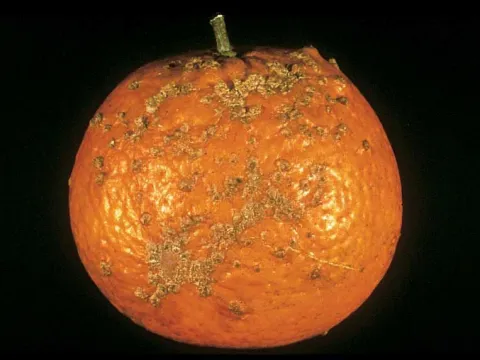
Citrus melanose
Diaporthe citri
The causative agent of the disease is the ascomycete fungus Diaporthe citri (anamorph Phomopsis citri). It belongs to the Diaporthaceae family and is a significant pathogen affecting various citrus species globally.
What the section contains
Citrus melanose
The fungus functions both as a saprophyte on dead twigs and as a parasite on living plant parts. It completes its life cycle by producing pycnidia with conidia and perithecia with ascospores, allowing it to persist in the orchard environment.
Infection primarily occurs through stomata or mechanical injuries on the epidermis. High humidity facilitates the production of conidial masses, which serve as the primary inoculum for spreading the disease within the tree canopy.
The pathogen is known to survive for extended periods in dead wood, fallen leaves, and mummified fruits. This reservoir of inoculum makes sanitation a primary concern for citrus growers.
In laboratory diagnostics, Diaporthe citri is identified by isolating the fungus on culture media, where it forms distinct, light-colored mycelia characterized by the presence of numerous small black pycnidia.
The fungus is best known for causing "melanose," a disease affecting leaves, young shoots, and fruits. It significantly reduces the aesthetic quality of the fruit, making them unsuitable for the fresh market.
Another major impact is "stem-end rot" (diplodia rot), which can lead to substantial post-harvest losses as the fruit degrades rapidly during storage and transportation.
Infection of young leaves leads to premature leaf drop and stunted growth. When branches are heavily colonized, it results in dieback, which gradually compromises the overall vigor of the citrus tree.
Fruits affected by melanose display hardened, scab-like lesions, which, although often superficial, disqualify the produce from premium export grades.
The economic impact involves both the direct loss of harvest and the necessity for recurring costs associated with fungicide applications and additional orchard management practices.
The spread of the disease is highly dependent on environmental conditions, particularly humidity and rainfall. Conidia are spread by splashing water and rain, which transport the inoculum across the orchard.
The most vulnerable stage for the plant is during the growth of young shoots and fruitlets. Frequent rainfall during these periods usually triggers widespread outbreaks of the disease.
Optimal temperatures for spore germination and colonization range between 20°C and 25°C. These conditions are common in many citrus-growing regions during the spring season.
In periods of prolonged dry weather, the development of the fungus slows significantly, but the pathogen persists in the dormant state within the infected twigs.
Management of the disease must be proactive, focusing on critical infection windows when moisture-dependent spore release is likely to occur.
Melanose symptoms appear as small, dark, raised dots on the surface of leaves or fruit, giving them a rough, sandpaper-like texture that can be felt by touch.
Fruits often exhibit "tear-stain" patterns, where rain-washed spores create streaks of clustered lesions as water flows down the surface of the fruit skin.
On stems and branches, infection manifests as necrotic areas and bark cracking. This often leads to the oozing of gum (gummosis) as the plant attempts to seal off the fungal penetration site.
Stem-end rot initially appears as a soft, discolored patch around the fruit button. As the fungus progresses, the decay moves rapidly toward the center of the fruit.
Advanced stages of stem-end rot are accompanied by a distinct, fermented odor and, under high humidity, a fine, grayish mycelial growth may appear on the fruit surface.
The most effective strategy is intensive sanitation. This includes pruning and removing dead and diseased wood from the tree canopy, as this is the primary source of the inoculum.
Orchard hygiene should also include disinfecting pruning tools to prevent the accidental transfer of spores from infected trees to healthy sections of the orchard.
Chemical control focuses on applying copper-based fungicides during the critical periods of fruit set, which helps protect the developing tissues from primary infection.
Post-harvest treatments, such as dipping fruits in antifungal solutions, are essential to minimize the development of stem-end rot during the distribution chain.
- Maintain an open tree canopy through strategic pruning to promote rapid drying.
- Optimize plant nutrition to strengthen host resistance against pathogen invasion.
- Proper disposal of prunings through burning or burying to eliminate the fungal reservoir.