
Citrus psorosis
Citrus psorosis
Citrus psorosis is a destructive viral disease caused by the Citrus psorosis virus (CPsV), which is a member of the Ophioviridae family and the Ophiovirus genus.
What the section contains
Citrus psorosis
The virus is composed of a segmented single-stranded RNA genome. Unlike many other plant viruses, it is not transmitted by common insect vectors but spreads primarily through vegetative propagation.
The disease is characterized by an extremely long latent period, often spanning many years before the first visible symptoms appear on the bark or foliage.
Transmission occurs mainly through the use of infected budwood during grafting operations, making nurseries the critical point for disease control.
Diagnosis in commercial orchards relies on ELISA or PCR techniques to detect the presence of viral proteins or RNA in plant tissues, especially when trees appear asymptomatic.
The disease affects a wide range of citrus species, including sweet orange, grapefruit, and mandarin. It is globally recognized as a limiting factor in citrus production.
The virus disrupts vascular tissue functions, leading to impaired nutrient transport throughout the tree. This results in physiological decline and stunted growth.
Infected trees suffer from significant yield losses, producing fewer and smaller fruits, which renders the orchard economically unviable over time.
As the disease progresses, the structural integrity of the tree is compromised. The cumulative damage eventually leads to the death of the tree.
Spread within a nursery or orchard happens when contaminated tools are used for pruning or grafting without proper sterilization, facilitating systemic infection.
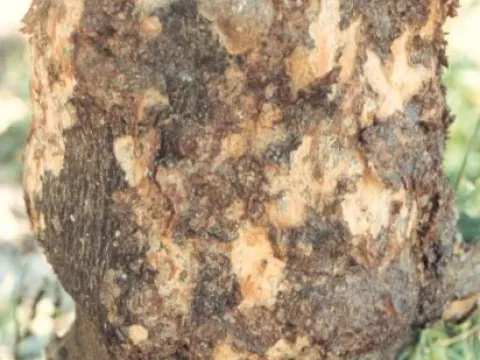
The hallmark sign of psorosis is the scaling of the bark on the trunk and primary branches. The outer bark separates in layers, resembling fish scales or dry crusts.
Young leaves may exhibit faint flecking or clearing of the veinlets. This symptom often appears in spring and may vanish as the leaves mature.
Internal wood lesions often contain pockets of gum (gummosis). This prevents proper water and nutrient flow, leading to canopy dieback.
Tree decline is characterized by sparse foliage, yellowing of leaves, and the progressive death of terminal branches.
- Bark scaling and flaking
- Vein clearing on leaves
- Gummosis in internal wood
- Reduced leaf size
- Canopy dieback
The most effective strategy for control is the use of certified, virus-free budwood. Establishing a strict budwood certification program is essential for all nurseries.
Regular sanitation of pruning tools using appropriate disinfectants is crucial to prevent the mechanical transmission of the virus between healthy and infected trees.
When an infected tree is identified, it must be removed promptly from the orchard and destroyed to prevent it from serving as a source of inoculum.
Avoid sourcing any propagating material from orchards where psorosis has been detected, even if the individual trees appear free of symptoms.
Since there is no curative treatment for trees once they are infected, preventing the introduction of the virus into the grove is the only viable management approach.