
Citrus exocortis
Citrus exocortis
Citrus exocortis is caused by the Citrus exocortis viroid (CEVd). It is a small, single-stranded circular RNA molecule that does not encode any proteins, relying entirely on the host's cellular machinery for replication.
What the section contains
Citrus exocortis
Taxonomically, it belongs to the genus Pospiviroid within the family Pospiviroidae. Its simple structure makes it highly resilient and capable of surviving on tools for extended periods.
The viroid is primarily transmitted mechanically. Contaminated pruning shears, knives, and other orchard equipment are the main vectors during grafting and pruning activities.
It can also be spread through root-to-root contact in high-density plantings, although this is secondary compared to human-mediated transmission via tools.
Detection is complex as the viroid is asymptomatic in many cases. Diagnostic methods include RT-PCR, molecular hybridization, and biological indexing using indicator plants.
The disease affects most commercial citrus species, including lemons, grapefruits, and citrons. Trifoliate orange rootstocks are particularly known for their extreme sensitivity to CEVd.
Damage manifests as stunted growth and a significant reduction in overall plant vigor. Infected trees become unproductive and eventually cease to bear viable fruit.
Long-term impact involves the gradual decline of the canopy, leading to dieback of branches and potential total collapse of the tree architecture.
Fruit quality is severely impacted; the fruits are often smaller, lack juice content, and may have altered sugar-acid balances, making them unsuitable for market.
The cumulative loss across an orchard leads to reduced profitability and the eventual necessity to remove large blocks of trees, impacting farm sustainability.
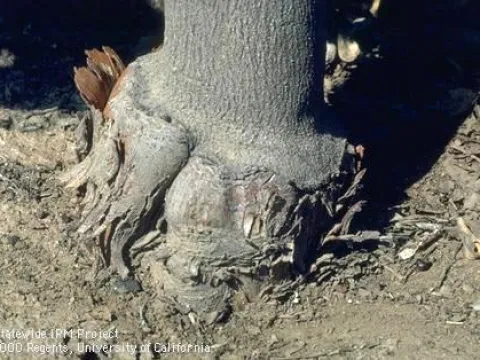
The most diagnostic feature is the scaling of the bark on the rootstock portion of the tree. The bark peels away in long, vertical strips, giving the trunk a shaggy or "exocortis" appearance.
Foliage symptoms include yellowing, curling, and overall chlorosis. Leaves may appear smaller than normal and show signs of nutrient deficiency despite proper fertilization.
The tree exhibits reduced canopy density due to the failure of new shoots to develop properly. This "thinning" of the foliage is a late-stage warning sign.
Bark cracks on the rootstock often exude gum, which indicates the pathogen is interfering with the phloem and transport functions of the tree.
- Vertical bark scaling on rootstock.
- Severe stunting of tree height.
- Chlorotic and deformed leaves.
- Reduced fruit size and quality.
- Progressive dieback of canopy branches.
Control focuses on prevention through the use of certified virus-free budwood. Only propagation material tested and cleared of CEVd should be used.
Strict sanitation protocols for pruning and grafting tools are essential. Tools should be thoroughly cleaned and disinfected with sodium hypochlorite or ethanol between each tree.
Once a tree is confirmed as infected, it should be immediately removed and destroyed. Leaving infected trees in the orchard provides a reservoir for continued transmission.
Choosing tolerant rootstocks that are resistant or immune to CEVd is a primary strategy for growers in areas where the viroid is known to exist.
Regular visual inspections and periodic testing of orchard blocks allow for early detection and containment, preventing an epidemic within the plantation.