
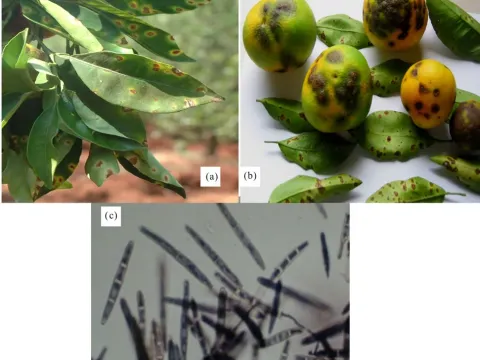
Citrus leaf spot
Pseudocercospora angolensis
The causative agent of this disease is the fungus Pseudocercospora angolensis, belonging to the Ascomycota division. It is a significant phytopathogen that primarily affects Citrus species across Africa and parts of Asia.
What the section contains
Citrus leaf spot
The fungus develops its mycelium within the plant tissues, leading to necrotic lesions. It reproduces via conidia, which are dispersed by wind and rain splashes, allowing the pathogen to spread quickly within orchards during favorable weather conditions.
The pathogen's biological cycle is closely tied to the tropical and subtropical climate. It thrives by producing spores on the surface of infected leaves and fruit, maintaining a high level of infection within the tree canopy.
Internally, the parasite forms stromata that produce conidiophores and conidia. High air humidity and moderate temperatures are essential for its development, making orchards particularly vulnerable during heavy rainy seasons.
Due to its high virulence, this pathogen is classified as a quarantine organism in many countries. Strict phytosanitary protocols are in place to prevent its introduction through imported planting material and fruit.
The disease primarily attacks leaves, young shoots, and fruits of citrus crops. It results in premature leaf drop, which significantly weakens the trees and reduces their overall photosynthetic capacity and fruit-bearing potential.
Infected fruits become commercially unviable. The lesions on the rind lead to deformation and rot, often exacerbated by secondary opportunistic microorganisms that colonize the weakened tissue.
In severe cases, the infection leads to dieback of branches and the overall decline of citrus groves. This drastically shortens the economic life of the plantation and necessitates costly management interventions.
Crop losses can range from 50% to 100% depending on the severity of the infection and the weather conditions during the growing season. Affected fruit lose their market quality and organoleptic properties.
Chronic infection forces the tree to expend valuable resources, leading to exhaustion and, in extreme cases, the total death of the tree. Effective disease management is crucial for the long-term sustainability of the orchard.
Initial symptoms appear as small spots on the leaves, which gradually expand. These spots are typically circular and surrounded by a distinct yellow halo, making them easily identifiable upon close inspection.
Grayish or brownish fungal mats develop on the surface of these spots, representing active sporulation. As the infection progresses, the tissues within the spots may die and drop out, resulting in a shot-hole effect on the leaves.
Fruit symptoms are similar, characterized by spots that may become sunken over time. The rind often darkens in these areas, which becomes more evident as the fruit matures and changes color.
- Premature yellowing and shedding of leaves.
- Circular brown leaf spots with yellow halos.
- Sunken necrotic lesions on the fruit rind.
- Sporulation visible as dark or grayish spots in the center of lesions.
- Stunted growth of new shoots and deformed fruit development.
Laboratory analysis is often required for definitive identification, as visual symptoms can sometimes be confused with other fungal or bacterial leaf spots commonly found in citrus-growing regions.
Strict quarantine measures are the primary defense: moving infected plant material, including nursery stock and fruit, from endemic to non-endemic areas is strictly prohibited to stop the pathogen's spread.
Agricultural management includes regular pruning of infected branches and the removal of leaf litter, which serves as a reservoir for fungal spores. Improving airflow within the canopy helps keep humidity levels low.
Chemical control involves the preventative and curative application of copper-based fungicides or other systemic products effective against Ascomycota. Regular spray schedules are essential during high-risk seasons.
Monitoring citrus groves for early symptoms is critical. Early detection allows for immediate action, such as the localized destruction of infected plant parts to prevent further dissemination of spores.
Establishing orchards with certified, disease-free nursery stock is the best defense. A comprehensive approach, combining orchard sanitation and targeted chemical application, is necessary to manage this pathogen effectively.