
Citrus leaf miner
Citrus leaf
The Citrus leaf miner, known scientifically as Phyllocnistis citrella, is a tiny moth belonging to the family Gracillariidae that specifically targets citrus plants.
What the section contains
Citrus leaf miner
Adult moths are very small, with a wingspan of about 4-5 mm, and possess a silver-white color with distinctive black spots and fringes on the wings.
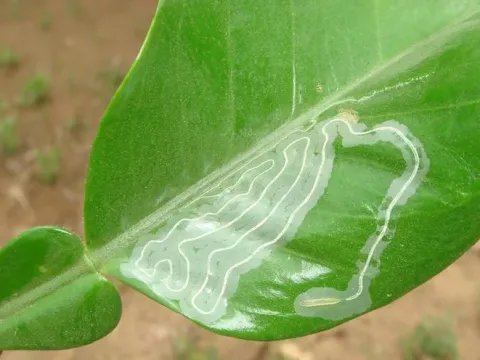
The damage is caused exclusively by the larval stage, which feeds on the leaf tissue, creating winding tunnels just beneath the epidermis of the leaves.
The life cycle is rapid, typically completing in 2 to 3 weeks depending on climate, which allows for multiple generations during a single growing season.
It thrives in warm and humid conditions, which are ideal for its reproduction and larval development, often leading to severe infestations in citrus orchards.
This pest prefers young, developing leaves and shoots of citrus species such as lemon, lime, orange, and grapefruit, causing significant structural damage.
As larvae feed on the leaf, they create mines that disrupt photosynthetic activity, weakening the overall health of the citrus tree and inhibiting its growth.
The leaf mines act as entry points for pathogens, most notably Citrus Canker (Xanthomonas citri), which can be devastating for the citrus industry.
Heavy infestations lead to leaf curling, premature leaf drop, and stunted tree development, ultimately reducing the quantity and quality of fruit yields.
Seedlings and young nursery stock are particularly susceptible to the damage caused by the leaf miner, as they have fewer leaves to support their growth.
The most visible sign of infestation is the appearance of silvery, snake-like trails or mines on the upper or lower surfaces of citrus leaves.
Young leaves showing signs of infestation often exhibit curling or rolling at the margins, which is a defensive reaction to the feeding activity of the larvae.
When held up to the light, one can observe a dark, continuous line of frass (excrement) within the silvery mines, indicating the presence of active larvae.
Over time, the affected leaves may turn yellow, brown, and necrotic, leading to their premature abscission, especially under water stress conditions.
- silvery winding trails on leaf surfaces
- curling and distortion of young leaves
- dark frass lines visible inside the mines
- browning and necrotic areas on leaf tissue
Systemic insecticides are the most effective chemical control method, as they are absorbed into the leaf tissue where the larvae are protected.
Biological control programs, using parasitoid wasps such as Ageniaspis citricola, have shown great success in managing populations in many countries.
Cultural practices, such as pruning and removing heavily infested shoots, help to reduce the population pressure and limit the spread of the larvae.
Pheromone traps are essential for monitoring the adult population flight, allowing growers to time their control interventions precisely for maximum efficacy.
Managing irrigation and nutrient application to avoid excessive flushes of succulent new growth can help make the trees less attractive to the pest.