
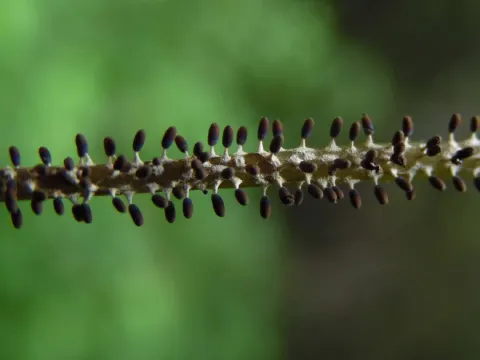
Diachea leucopodia
Diachea leucopodia
Diachea leucopodia is a species of slime mold belonging to the phylum Myxomycota. Unlike true fungi, it exists as a mobile, multinucleate mass of protoplasm called a plasmodium during its vegetative stage.
What the section contains
Diachea leucopodia
The organism is easily recognized by its distinctive fruiting bodies (sporangia). These structures are typically metallic or iridescent in appearance and are supported by a prominent, white, calcareous stalk.
Sporangia are often clustered in large numbers on the surfaces of living plants, dead leaves, or mulch, forming a visible layer that can be dark bronze or nearly black when mature.
Reproduction is carried out through spores that are released into the environment. These spores germinate under favorable moisture conditions to produce swarm cells or myxamoebae, which eventually fuse to reform the plasmodium.
While often confused with fungal pathogens, this organism is technically a saprotroph that obtains nutrients by engulfing bacteria and decaying organic matter found on the surface of plant tissues.
Diachea leucopodia does not typically invade plant tissue to cause systemic disease. However, it can significantly impact the health of plants through physical interference.
By forming a dense coating of slime or fruiting bodies over leaves and stems, the organism blocks sunlight and inhibits photosynthesis. This can lead to localized yellowing or necrosis of the leaf blade.
Turf grasses and ornamental plants are particularly prone to aesthetic damage. The presence of these crust-like patches makes lawns and flower beds look untidy and can reduce the marketability of nursery stock.
In high-density plantings, the thick layer of the organism traps moisture against the plant surface, potentially creating an ideal microenvironment for opportunistic pathogenic fungi and bacteria.
While the organism itself is rarely lethal to a healthy plant, severe infestations can stunt growth in young or sensitive seedlings due to the interference with gas exchange and nutrient absorption processes.
The activity of Diachea leucopodia is strictly dependent on moisture availability. It is most prevalent during periods of frequent rainfall, high humidity, and overcast skies.
Spring and summer are the peak times for occurrence, particularly following long-duration moisture events that keep leaf surfaces wet for extended periods.
The organism flourishes at temperatures between 15°C and 25°C. Under these conditions, the plasmodium can move across surfaces and complete its life cycle in a relatively short period.
Persistent dew or morning fog is often enough to sustain the organism in shaded areas, where evaporation is slow and the environment remains conducive to slime mold development.
As weather conditions turn dry or temperatures fluctuate significantly outside of the optimal range, the plasmodium retreats or forms mature spores, which remain dormant until the next wet cycle.
Control of Diachea leucopodia is primarily focused on altering the environment to make it less hospitable for slime mold formation rather than using heavy chemical treatments.
Cultural management is highly effective: improve air circulation around plants through thinning, pruning, and consistent mowing to reduce the humidity levels within the canopy.
Irrigation scheduling plays a critical role. Watering should be done early in the day, ensuring that foliage has enough time to dry off completely before the onset of cooler evening temperatures.
Removing thatch and decaying organic matter from the base of plants reduces the food source and moisture-retention capacity of the substrate, limiting the organism's spread.
If physical removal is necessary, a gentle wash with a high-pressure water spray can dislodge the plasmodium, or simple brushing can remove the mature sporangia from the leaves.