
Cladosporiosis
Cladosporum
Cladosporiosis is a common plant disease complex caused by fungi of the genus Cladosporium. Biologically, these fungi belong to the kingdom Fungi and the phylum Ascomycota. They are well-known as ubiquitous saprotrophs, but many species act as significant phytopathogens for agricultural crops.
What the section contains
Cladosporiosis
The fungus produces masses of conidia that are easily dispersed by air currents, splashing water, or handling. Due to its high survival capacity in crop residues and soil, it remains a persistent threat in greenhouse environments where strict sanitary protocols are not followed.
The disease is particularly destructive to tomatoes (causing leaf mold), cucumbers, and various ornamental plants. It primarily targets the foliage, disrupting photosynthesis by destroying the tissue of the leaves, which significantly impacts the development and ripening of fruits.
High levels of infection result in premature defoliation of the plants, which severely restricts the plant's ability to produce energy. In severe cases, particularly in intensive cultivation systems, the yield loss can be total, making effective management crucial for commercial production.
Cladosporium pathogens thrive in conditions of high humidity (above 80%) and moderate temperatures ranging from 20°C to 25°C. These conditions are frequently encountered in poorly ventilated greenhouses during the summer months.
The infection cycle begins when airborne spores land on host tissue. If moisture is present, the spores germinate and penetrate the plant through stomata. The fungus then colonizes the intercellular space, eventually emerging through the stomata to produce new conidia for further spread.
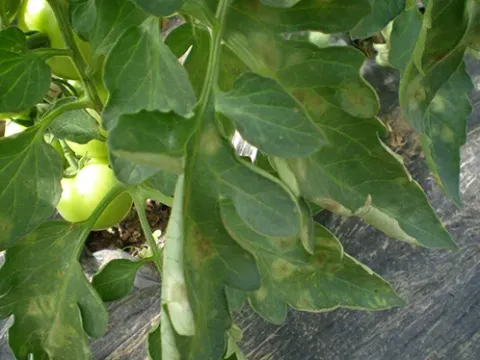
Early symptoms appear as small, pale green or yellowish spots on the upper leaf surface. As the fungus colonizes the internal tissue, these spots gradually turn brown. On the underside of the leaf, an olive-green to brown velvety growth of spores is clearly visible.
As the infection progresses, the spots expand and coalesce. The leaves turn yellow, then brown, and eventually wither and die. In advanced stages, the plant's growth is stunted, and the fruits fail to reach maturity or show poor quality and flavor.
Effective control is rooted in creating an environment that is unfavorable for fungal growth. Reducing humidity through proper ventilation and optimizing irrigation methods is the first line of defense against the spread of the pathogen.
- Maintaining proper spacing between plants to improve airflow.
- Removing and incinerating infected leaves and debris.
- Choosing resistant plant cultivars for greenhouse production.
- Applying fungicides specifically labeled for leaf mold control.
- Ensuring thorough sanitation of greenhouse structures between seasons.