
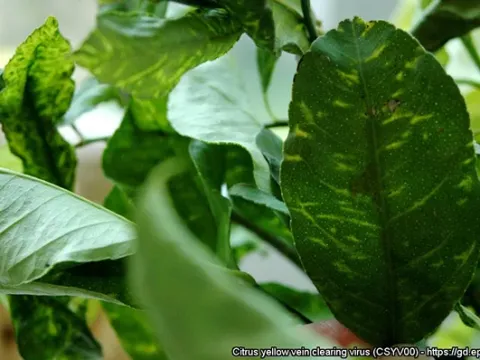
Citrus yellow
Citrus yellow
Citrus yellow is a systemic plant disease caused by phytoplasmas, which are specialized wall-less bacteria that inhabit the phloem of host plants. These pathogens are obligate parasites and cannot survive independently of their hosts or insect vectors.
What the section contains
Citrus yellow
The transmission of the pathogen occurs primarily through the feeding activities of phloem-sucking insects, such as psyllids and leafhoppers. Once the insect acquires the phytoplasma, it carries the pathogen throughout its lifespan, infecting every healthy citrus plant it feeds upon.
Phytoplasmas multiply within the phloem tissues, causing obstruction in the translocation of sugars and nutrients. This physiological disturbance is the primary cause of the systemic decline observed in infected trees.
Molecular detection, such as PCR assays, is the standard method for identifying these infections, as symptoms can often be misinterpreted as nutrient deficiencies or environmental stress.
The disease spread is largely influenced by the presence and population density of the insect vectors, which are often more active in specific climate zones suitable for citrus cultivation.
The disease affects a wide range of citrus species, including lemons, oranges, mandarins, and grapefruits. It leads to a progressive decline of the entire plant, which ultimately results in the total loss of productivity.
Infected trees exhibit reduced fruit size, poor fruit quality, and significant yield losses. In commercial orchards, this can render the entire plantation economically non-viable within a few years of infection.
Nursery operations are particularly at risk, as the use of infected budwood can lead to the widespread dissemination of the pathogen into new, healthy orchards before symptoms are even visible.
Beyond the loss of harvest, the disease shortens the lifespan of the citrus trees, causing premature senescence and eventual death of the entire canopy.
The weakened state of infected trees makes them susceptible to opportunistic infections, complicating disease management and orchard maintenance efforts.
Initial symptoms include yellowing of the leaves, which often begins along the veins and spreads across the entire leaf blade. This yellowing is frequently uneven, contrasting with the uniform chlorosis seen in mineral deficiency.
One of the most characteristic signs is the development of thin, stunted shoots, often referred to as 'witches' broom', resulting from the abnormal activation of dormant buds.
Fruit set is heavily affected; the fruits produced are typically small, misshapen, and may display uneven coloring or reduced sugar content, making them unfit for market.
As the disease progresses, the tree canopy starts to die back, starting from the outermost branches and moving towards the main trunk, leaving a skeletal appearance.
Root system deterioration is also common, with necrotic lesions often visible in the phloem of the roots and lower stems upon examination.
Since there is no curative treatment for trees already infected with phytoplasmas, management focuses on eradication and strict preventive measures.
Infected trees must be promptly removed and destroyed to eliminate them as reservoirs for the pathogen, preventing further spread to healthy plants by insect vectors.
Integrated Pest Management (IPM) strategies, including the use of systemic insecticides to control leafhopper and psyllid populations, are essential in regions where the disease is prevalent.
Only certified, disease-free nursery stock should be used for new plantings. Rigorous quarantine protocols and regular testing of nursery material are crucial for preventing the introduction of the disease.
- Sanitize pruning tools regularly to prevent mechanical transmission.
- Establish buffers between young plantations and older, potentially infected trees.
- Monitor for insect vectors continuously during the growing season.