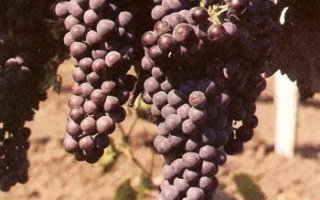
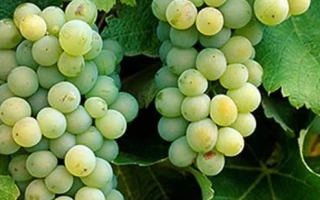
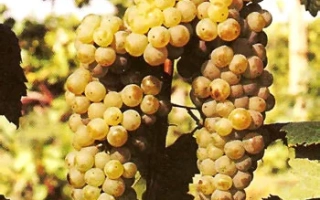
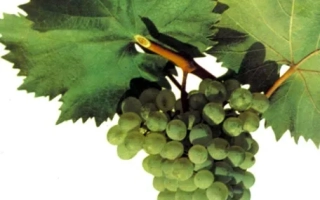
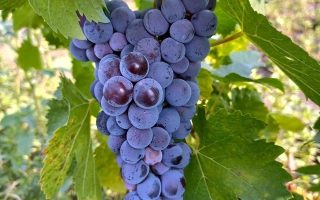
Riparia x Rupprechtis 101-14 — this is a grapevine rootstock developed in France, widely used in viticulture due to its unique agrobiological characteristics. The vines are medium-sized, with a well-branched root system of moderate strength, which is less robust than rootstocks of the Berlandieri x Riparia group. The cane matures approximately 80%, and the total volume of one-year growth mass is about 1100 cm³. The rootstock exhibits high resistance to fungal diseases such as mildew and oidium, as well as very high resistance to root forms of phylloxera, making it a reliable choice for various soils and climatic conditions. The plant's appearance features small, round, dark berries and leaves of medium or large size, characteristic of Vitis Riparia. The leaves are entire, wedge-shaped, light green with reddish edges and pale-pink veins, slightly wrinkled and without pubescence. Young shoots are light-brown with a reddish tint and slight pubescence. Flowers are hermaphroditic, though occasionally variations with functionally female or male types occur. Inflorescences are cylindrical and unbranched, while clusters are small and of medium density. Riparia x Rupprechtis 101-14 exhibits high frost resistance of roots and buds, as well as moderate drought tolerance. The variety is relatively non-demanding regarding soils and can withstand up to 9% soluble carbonate forms. However, due to strong susceptibility to leaf forms of phylloxera, it requires regular insecticide treatments. Successful cultivation requires complex agronomic practices, including head training and active shoot thinning. The vegetation period lasts approximately 170–180 days at a sum of active temperatures of 3100–3500 °C, allowing its use in various climatic zones, including southern Ukraine.