

SKU #46101
·
76 views
Aghadaï
Grape
User rating
0 votes0% positive reviews
No ratings yet — be the first.
Usage Group
Dining
Ripening Period
Mid-late
Cold Resistance
Average (up to -21°C)
Resistance to Mildew
Low
About product

Aghadaï — a Dagestan table grape variety of medium-late ripening, belonging to the eastern eco-geographical group. Bushes are vigorous with good cane maturation. Leaves are large, five-lobed, light green, with sparse hairs along the veins and a closed petiole sinus. Bunches are large, cylindrical-conical, medium density or loose, decorative. Berries are large and very large, oval or elongated, lig…
Usage Group
Dining
Ripening Period
Mid-late
Cold Resistance
Average (up to -21°C)
Resistance to Mildew
Low
Description
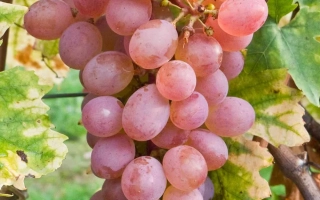
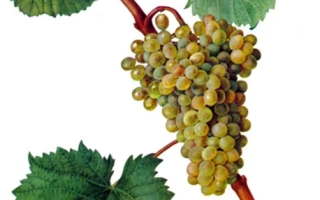
Aghadaï — a Dagestan table grape variety of medium-late ripening, belonging to the eastern eco-geographical group. Bushes are vigorous with good cane maturation. Leaves are large, five-lobed, light green, with sparse hairs along the veins and a closed petiole sinus. Bunches are large, cylindrical-conical, medium density or loose, decorative. Berries are large and very large, oval or elongated, light greenish-yellow with a yellowish-pink hue on the sun-exposed side, covered with a medium layer of waxy bloom (pruina). Skin is medium-thick, firm, and difficult to separate from the flesh, which is dense, slightly juicy, and crisp. Flavor is simple, slightly bitter, sometimes described as quite pleasant but somewhat bland. Berries contain 3-5 large seeds.
The period from bud break to harvest maturity is 138-160 days with a sum of active temperatures around 2955°C. Sugar content reaches 14-15%, sometimes up to 16-21 g/100 cm³, acidity varies from 5 to 9 g/L. Yield is high — 100-130 centners per hectare and above, though it may be inconsistent and depends on pollination conditions. The variety has moderate winter hardiness, good drought tolerance, and relatively high salt tolerance. Cane maturation is rated as good or satisfactory.
Aghadaï is resistant to gray rot and shows high resistance to fungal diseases, but it is weakly resistant to mildew and moderately resistant to oidium, requiring careful cultivation. The grape has high transportability and storability — berries can be stored for up to 2-3 months under home conditions. The variety is widely used for fresh consumption and is suitable for making jams and marinades, making it versatile and popular.
The period from bud break to harvest maturity is 138-160 days with a sum of active temperatures around 2955°C. Sugar content reaches 14-15%, sometimes up to 16-21 g/100 cm³, acidity varies from 5 to 9 g/L. Yield is high — 100-130 centners per hectare and above, though it may be inconsistent and depends on pollination conditions. The variety has moderate winter hardiness, good drought tolerance, and relatively high salt tolerance. Cane maturation is rated as good or satisfactory.
Aghadaï is resistant to gray rot and shows high resistance to fungal diseases, but it is weakly resistant to mildew and moderately resistant to oidium, requiring careful cultivation. The grape has high transportability and storability — berries can be stored for up to 2-3 months under home conditions. The variety is widely used for fresh consumption and is suitable for making jams and marinades, making it versatile and popular.
Crop & resistance
Crop
Disease resistance
Specifications hover over for a hint about the specification
| Usage Group | |
|---|---|
|
Ripening Period
Ripening Period
It takes 70-100 days until pepper reaches flowering stage, 130-160 days until technical fruit ripeness, and 135-180 days until physiological ripeness. |
Mid-late |
| Cold Resistance | |
| Resistance to Mildew | |
| Resistance to oidium | |
| Resistance to Gray Mold | |
|
Yield
Yield
Overall bulb harvest per unit area. Depends on both onion variety characteristics and agronomic practices, fertilizers, and irrigation. Under optimal growing conditions, an onion yield of 100 tons per hectare and above is not considered record-breaking. |
High |
| Bush Growth Power | |
| Bunch Size | Large (500–800 g) |
| Berry Size | Very large (>8 g) |
| Flavor | |
| Sugar Content | Average (16–20%) |
| Care Requirement | |
| Assignment | |
| Features | |
| Registration year | 1958 |
| Catalog | Catalog → Grape |
| Country | Ukraine |
Store offers
Prices are updated on loadLoading offers…
Aggregator catalog: prices are collected automatically from store websites, normalized by AI and converted at the current exchange rate. Before ordering, confirm the price and availability on the store's website. This block is not indexed by search engines — the data is loaded after the page opens.
Not yet комментариев. Be the first!
Alternatives
Grapevine saplings · similar varieties




See also
Often considered together with this variety






Recently viewed
Products you’ve viewed on this site
Reviews · 0