



SKU #72993
·
58 views
NUKH RAT
Tarragon
User rating
0 votes0% positive reviews
No ratings yet — be the first.
Days until first harvest
30-40
Usage
Culinary, Medicine, Vinegar Aromatization
Essential oil content, %
0.3-0.5
Registration year
2021
About product

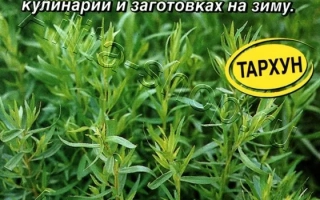
Tarragon (Artemisia dracunculus L.), also known as tarhun, is a perennial herbaceous plant of the Asteraceae family. The 'Nukhrat' variety is distinguished by its tall vertical form and small green leaves up to 8 cm long, making it particularly attractive for commercial cultivation. The plant reaches a height of 120–140 cm, while the period from regrowth to the first greens harvest is only 30–40 d…
Days until first harvest
30-40
Usage
Culinary, Medicine, Vinegar Aromatization
Essential oil content, %
0.3-0.5
Registration year
2021
Description
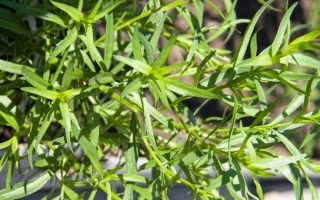
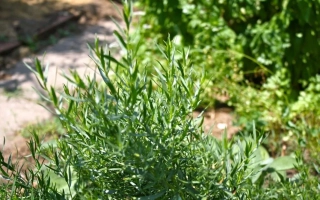
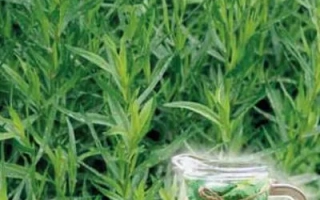
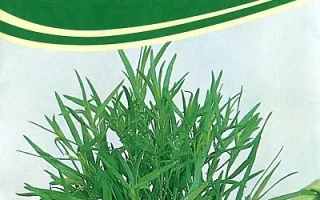
Tarragon (Artemisia dracunculus L.), also known as tarhun, is a perennial herbaceous plant of the Asteraceae family. The 'Nukhrat' variety is distinguished by its tall vertical form and small green leaves up to 8 cm long, making it particularly attractive for commercial cultivation. The plant reaches a height of 120–140 cm, while the period from regrowth to the first greens harvest is only 30–40 days, ensuring a rapid product turnover.
Yield of greens with a single harvest ranges from 3.6–3.8 kg/m², and the mass of a single plant can reach 650 g. The above-ground part contains carotene, alkaloids, essential oil (content up to 0.4 % on raw mass), flavonoids, and vitamin C, giving the plant a rich aroma and beneficial properties. The essential oil contains sabinene, myrcene, a sesquiterpene fraction, and other components responsible for the characteristic smell.
Culinarily, tarragon is widely used both fresh and dried. Leaves are added to salads, soups, and broths, and are also used to flavor vinegar and wines. Traditionally, it is used when preparing fish, especially stewed, as well as a spice for meat and game. In folk medicine, tarragon is considered an anti-helminthic, antiseptic, and anti-inflammatory agent; it helps with stomach spasms, increases appetite, and aids digestion. Thanks to its aromatic and healing properties, 'Nukhrat' is in demand among both chefs and in folk practice.
Yield of greens with a single harvest ranges from 3.6–3.8 kg/m², and the mass of a single plant can reach 650 g. The above-ground part contains carotene, alkaloids, essential oil (content up to 0.4 % on raw mass), flavonoids, and vitamin C, giving the plant a rich aroma and beneficial properties. The essential oil contains sabinene, myrcene, a sesquiterpene fraction, and other components responsible for the characteristic smell.
Culinarily, tarragon is widely used both fresh and dried. Leaves are added to salads, soups, and broths, and are also used to flavor vinegar and wines. Traditionally, it is used when preparing fish, especially stewed, as well as a spice for meat and game. In folk medicine, tarragon is considered an anti-helminthic, antiseptic, and anti-inflammatory agent; it helps with stomach spasms, increases appetite, and aids digestion. Thanks to its aromatic and healing properties, 'Nukhrat' is in demand among both chefs and in folk practice.
Crop & resistance
Crop
Specifications
| Days until first harvest | 30-40 |
|---|---|
| Usage | |
| Essential oil content, % | 0.3-0.5 |
| Registration year | 2021 |
| Catalog | Catalog → Tarragon |
| Legal data |
Show · 1
|
| Country | Russia |
Store offers
Prices are updated on loadLoading offers…
Aggregator catalog: prices are collected automatically from store websites, normalized by AI and converted at the current exchange rate. Before ordering, confirm the price and availability on the store's website. This block is not indexed by search engines — the data is loaded after the page opens.
Not yet комментариев. Be the first!





See also
Often considered together with this variety



Recently viewed
Products you’ve viewed on this site
Reviews · 0