


SKU #71663
·
65 views
Candy
Rhubarb
СДК-СИДСUser rating
0 votes0% positive reviews
No ratings yet — be the first.
Stem Color
Green with a pink tint
Assignment
For jams and jellies
Registration year
2019
About product

A perfectly balanced variety for home canning and vitamin-rich beverage production.
Stem Color
Green with a pink tint
Assignment
For jams and jellies
Registration year
2019
Description
Practical potential of Rhubarb "Kompotny"
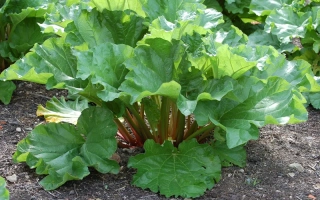
Rhubarb "Kompotny" by SDK-SIDS is a reliable choice for gardeners and farmers focused on establishing a consistent vitamin supply for processing. The variety fully justifies its name: its petioles feature an optimal balance of organic acids, making them an ideal raw material for canning. Unlike purely ornamental types, "Kompotny" was developed with culinary needs in mind: during heat treatment, it provides a rich taste and an appealing color due to the characteristic pink tint on the green stalks, eliminating the need for additives.
Agrotechnics and Cultivation Scenarios
To maximize the harvest of this rhubarb, growers should consider conditions typical for the variety:
- Site selection: The variety thrives on moist, well-drained soils rich in organic matter. Waterlogging should be avoided to prevent root rot.
- Sustainability: Rhubarb is a long-term investment. With proper care and regular organic fertilization, a single planting of "Kompotny" can remain productive for up to 8–10 years.
- Harvesting technique: To preserve the plant's vigor, it is recommended to snap the stalks off at the base rather than cutting them; this helps prevent damage to the renewal bud.
By choosing SDK-SIDS seeds, you ensure varietal purity, which is critical for perennial crops where the investment in time is significant. This variety serves as an excellent "spring starter" on the farm; as one of the earliest crops to produce a marketable yield, it allows for immediate processing of compotes and jams long before other seasonal fruits reach maturity.
Specifications
| Stem Color | |
|---|---|
| Assignment | |
| Registration year | 2019 |
| Catalog | Catalog → Rhubarb |
| Manufacturer | СДК-СИДС |
| Legal data |
Show · 1
|
| Country | Russia |
Store offers
Prices are updated on loadLoading offers…
Aggregator catalog: prices are collected automatically from store websites, normalized by AI and converted at the current exchange rate. Before ordering, confirm the price and availability on the store's website. This block is not indexed by search engines — the data is loaded after the page opens.
Not yet комментариев. Be the first!


See also
Often considered together with this variety





Recently viewed
Products you’ve viewed on this site
Reviews · 0