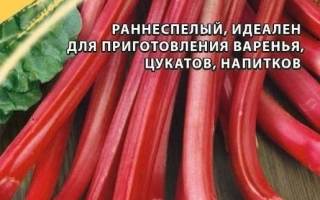
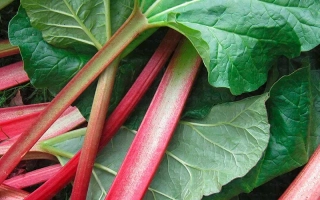
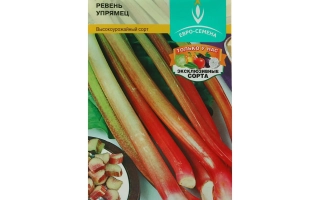
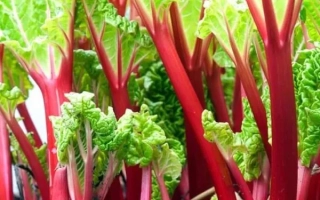
Rhubarb is a perennial herbaceous plant from the buckwheat family, valued both in cooking and in folk medicine. Its large leaf blades have a dark green color, weakly vesicular surface, and medium wavy edges with five veins emerging from the petiole. Petioles grow on stems 35–45 cm long, weighing 58 to 95 g, and are covered with a continuous cherry-red anthocyanin pigmentation at the base at the beginning of commercial maturity. The growth period from spring regrowth to the start of harvest lasts 22–26 days, during which one m² of plants yields 4.0 to 4.6 kg of petioles.
The internal composition of rhubarb is rich in organic acids and mineral salts – potassium, phosphorus, magnesium, calcium. In addition, the plant contains a large amount of tannins and vitamins, including vitamin K, which strengthens bones. These properties make rhubarb beneficial for digestion: fiber improves its function, while antioxidants protect against free radicals.
The use of rhubarb is diverse. Young petioles are used in making compotes, jellies, wines, kvass, marmalade, and candied fruits. In cooking, they are also included in jams, jellies, cakes, sauces, and other dishes. In folk medicine, rhubarb is used to improve digestion, stimulate appetite, as well as an antiseptic and laxative. Roots of some species are valued for their astringent effect at low doses and laxative effect at high doses.