Late-season variety selected at the Stavropol Experimental Station for Horticulture. Obtained by crossing Williams with Forest Beauty. Developed by P.V. Kuznetsov. Approved for the North Caucasus region.
Small tree, with a broad-pyramidal crown of medium density. Bark on the trunk is smooth and gray. Branches are arched, rounded, brown.
Shoots have a dark cherry color. Buds are small, few in number, curved, medium-sized, conical, smooth. Leaves are medium or slightly smaller, egg-shaped, short-pointed, dark green, smooth, matte. Leaf blade is concave, hairless, with fine-toothed margins. Petioles are long, medium-sized, bare. Stipules are small and elongated. Flowers are medium-sized, white. Petals are round.
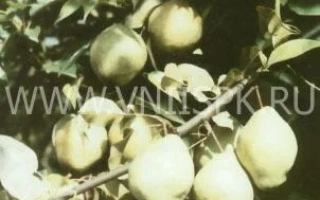
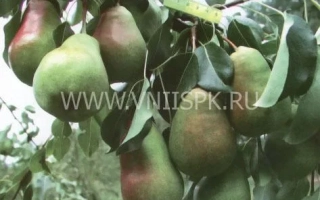
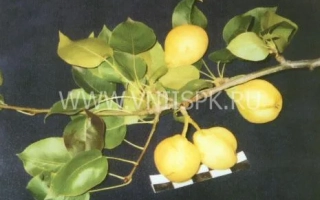
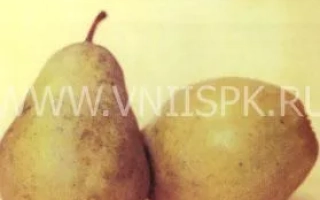
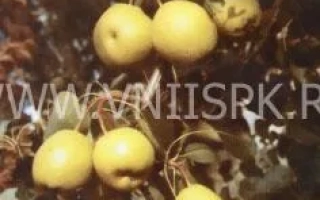
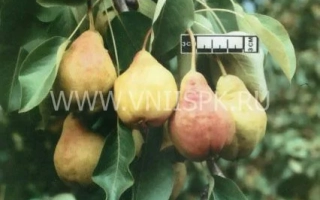
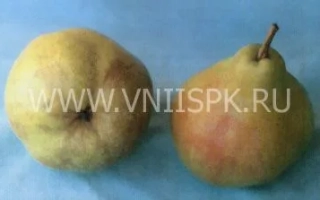
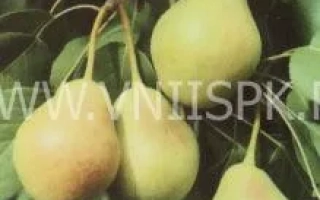
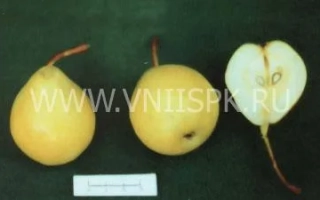
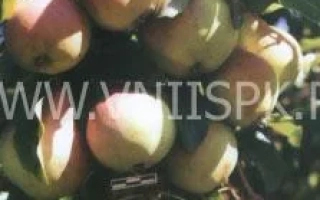
Fruits are very beautiful, one-dimensional, pear-shaped, warty, with regular shape. Skin is of medium thickness, oily, greenish-yellow at consumer maturity. Cover color covers most of the fruit, diffuse, red. Under-skin dots are medium-sized, green, clearly visible. Peduncle is medium, thick, curved, oblique. Calyx is absent, receptacle closed, plate small, broad, ridged. Heart is elliptical. Seed chambers are closed, seeds are medium, cup-shaped, light-brown.
Flesh is creamy, tender, oily, very juicy, sweet, aromatic. Chemical composition of the fruit: dry matter — 18.6%, sugars — 10.4%, titratable acids — 0.19%, ascorbic acid — 9.5 mg/100g.
Typical harvest period is from August 20 to September 5. Storage duration up to 20 days, in specialized storage — 1.5 months. Fruit quality is high. First-grade fruit yield is 90%.
Fruits harvested 10 days before consumer maturity (August 10-15) withstand transportation well.
Requires pollinators. Best pollinators are varieties: Klappa’s Favorite, Williams, Bere Bosk, Red Cheeked, Nalchikskaya Kostyka, Korsunskaya.
Trees begin fruiting at 7 years. Yield is high. Flowering and fruiting are regular. In the foothill zone of the Stavropol region, yield from 8-12-year-old trees grafted onto Caucasian Forest Pear was 153 centners/ha. Winter hardiness is high. The variety is relatively disease-resistant. During severe epidemics, its infection by scab reaches 0.5-1 point.
Advantages of the variety: high yield, high fruit quality, suitability for fresh consumption and various processing methods.
Disadvantages of the variety: fruits are highly susceptible to infection by Monilia fructicola.
Recommended for selection for larger fruit size and better fruit quality. Suitable for pear rootstocks.