


SKU #3662
·
365 views
Kuyumskaya
Pear
User rating
0 votes0% positive reviews
No ratings yet — be the first.
Type of Sort
Autumn variety of pear
Store offers · 2 from 2 stores
Prices are updated on loadLoading offers…
Available at: Сад Абраменко · Садовая Деревня
Aggregator catalog: prices are collected automatically from store websites, normalized by AI and converted at the current exchange rate. Before ordering, confirm the price and availability on the store's website. This block is not indexed by search engines — the data is loaded after the page opens.
About product

Early-autumn variety obtained at the Scientific Research Institute of Horticulture of Siberia named after M. A. Lisavensky by sowing seeds from open pollination of onion varieties. Breeders: V. S. Putov, I. A. Puchkin. Approved for the West Siberian region.
Small-sized tree with a round, moderately dense, well-leafed crown. Bark on main branches is smooth and brownish-green. The predominant t…
Type of Sort
Autumn variety of pear
Description
Early-autumn variety obtained at the Scientific Research Institute of Horticulture of Siberia named after M. A. Lisavensky by sowing seeds from open pollination of onion varieties. Breeders: V. S. Putov, I. A. Puchkin. Approved for the West Siberian region.
Small-sized tree with a round, moderately dense, well-leafed crown. Bark on main branches is smooth and brownish-green. The predominant type of fruit formations — simple and complex rings.
Shoots are straight or slightly arched, round in cross-section, brown.
Leaves are medium-sized, egg-shaped, light green with a helically twisted tip and finely serrated edges.
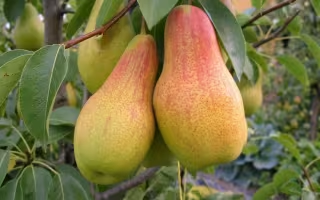
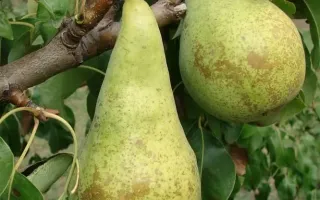
Fruits are small (weight 58 g), short pear-shaped. Skin is rough and uneven. Main color at harvest time is greenish-yellow, at consumer stage — light yellow, with no covering layer. Numerous lenticels: medium-sized, rust-colored. Peduncle is long, medium thickness, curved. Pit is not pronounced. Calyx does not fall off, open, shallow bowl-shaped, wide. Heart is large, onion-shaped. Seed chambers are closed, medium-sized. Subcalyx tube is short, sac-like. Seeds are medium-sized, conical, dark brown.
Flesh is white, dense, coarse, finely granular, of average taste. Chemical composition of fruits: total sugar content — 12.0% (10.8–13.5%), titratable acids — 0.62% (0.44–0.74), tannins — 202 mg/100g, ascorbic acid — 8 mg/100g (4.3–10.2), P-active compounds — 202 mg/100g (79–419).
Fruits ripen at the end of August, and can be stored for no more than 8 days. This is a technical variety.
Begins fruiting in the fourth year. High and regular yield. Exceptionally cold-hardy (on the level of Ussuri pear), well-transmitted to offspring. Highly resistant to fungal diseases.
Advantages of the variety: exceptional cold-hardiness, high yield.
Disadvantages of the variety: average fruit taste, short storage life.
Crop & resistance
Crop
Disease resistance
Specifications
| Type of Sort | |
|---|---|
| Catalog | Catalog → Pear |
Not yet комментариев. Be the first!
Alternatives
Pear saplings · similar varieties




See also
Often considered together with this variety





Recently viewed
Products you’ve viewed on this site
Reviews · 0