This variety was obtained at the Scientific Research Institute of Horticulture of Siberia named after M. A. Lisavenko by pollinating the variety 'Vnuchka' with pollen from the variety 'Desertnaya Mliyevskaya'. Breeders: I. A. Puchkin, I. P. Kalinina, E. P. Karataeva. Undergoing state variety testing in the West Siberian region.
Medium-sized tree with a sparse crown and 'leggy' (sparsely branched) skeletal branches and shoots, due to apical dominance. Leaves medium-sized, egg-shaped, dark green, finely toothed at the edges, on long petioles. Predominant fruiting type — simple and compound rings.
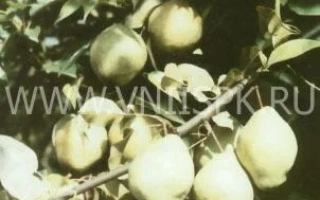
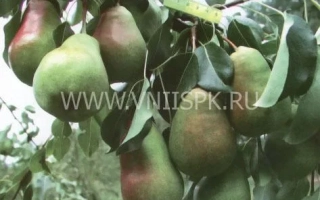
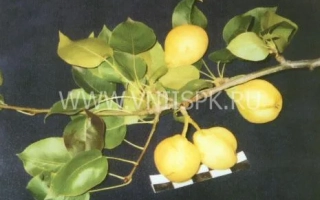
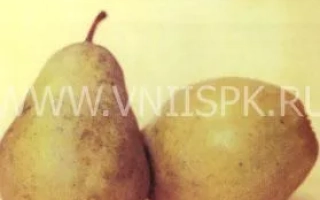
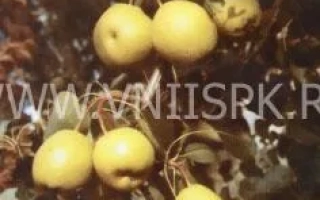
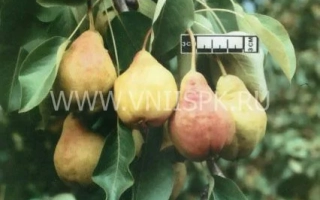
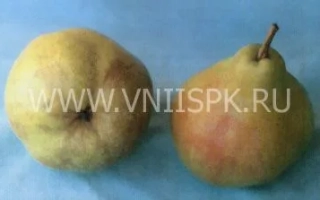
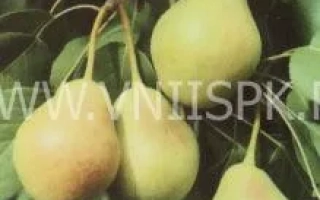
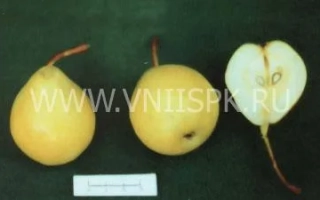
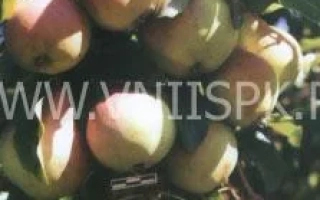
Fruits are below average size (107 g), broad pear-shaped or broad egg-shaped, on a long, slender peduncle. Skin is not rough, smooth, oily, shiny. Main color is whitish, covering color — a blurred, striped dark red blush covering most of the fruit. Numerous subcutaneous dots, green, clearly visible. No calyx depression. Calyx does not fall off, closed. Plate is small but wide. Heart is large, elliptical. Seed chambers are closed. Subcalyx tube is weakly expressed. Seeds are small, lanceolate, light brown.
Flesh is white, medium density, semi-oily, juicy, very succulent, tart-sweet, with a spicy flavor, good taste. Chemical composition of fruits: total sugar content — 12.2%, titratable acids — 0.64%, tannins — 62 mg/100g, ascorbic acid — 3.3 mg/100g, P-active substances — 62 mg/100g.
Fruits ripen in mid-September and can be stored for up to two weeks, in a refrigerator — up to two months.
Fruits are of universal use.
Beginning of fruiting — on the fourth to fifth year. Fruits moderately and regularly.
Winter hardiness of trees is insufficient, significantly lower than that of old Siberian lukašovka varieties, and reliable cultivation of this variety is possible only on sites with favorable microclimate. The variety is highly resistant to fungal diseases. Requires moisture.
Advantages of the variety: good consumer qualities of fruits, high resistance to fungal diseases.
Disadvantages of the variety: insufficient winter hardiness, requirement for moisture, need for special pruning to increase branching.