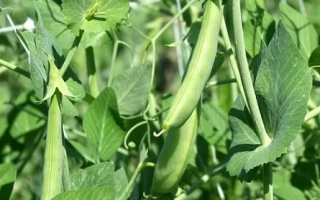
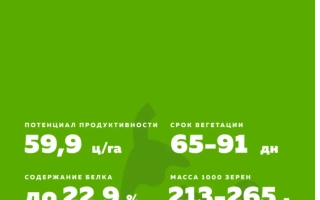
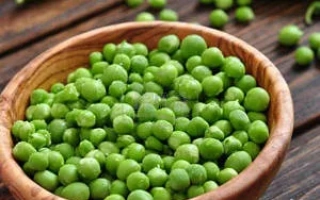
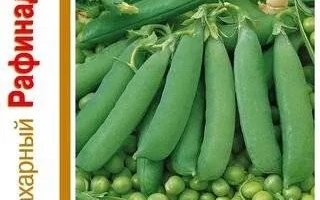
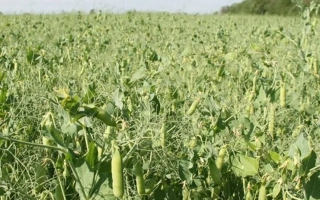
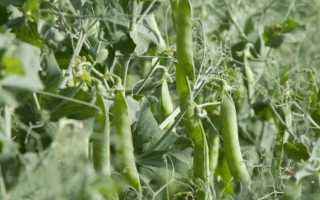
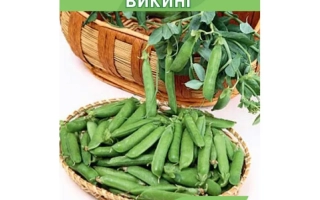
The Varis pea variety is a mid-season cultivar with a vegetation period of about 75 days, comparable to the Kazantsev variety. It belongs to leafless varieties with modified tendrillary leaves and plant height ranging from 48 to 78 cm. The stem and internodes are shortened, while the flowers are large and white. Pods are of medium size, weakly curved, and contain 4-5 seeds of light pink color, weighing 230-260 g per 1000 seeds. The variety is characterized by high resistance to seed shattering and plant lodging, which allows for efficient harvesting by direct combining. Varis demonstrates high yield, exceeding the standard indicators of the Kazantsev variety. Maximum yield values reached 5.60-5.71 t/ha, which is 0.48-0.51 t/ha higher than the standard. In various regions, such as the Central and Middle Volga regions, the yield is about 20.8-21.1 c/ha. Protein content in the grain varies from 21.1 to 24.4%, making this variety valuable for food and feed use. The variety has medium resistance to diseases, including root rot, rust, and anthracnose, while being susceptible to ascohitosis. Drought resistance is average, slightly inferior to the Kazantsev and Talovec 70 standards. The main advantages of the Varis variety are high resistance to shattering and lodging, which ensures crop preservation and facilitates mechanized harvesting, as well as stable high yield and good grain quality.