


SKU #4047
·
335 views
Amur
Apricot
User rating
0 votes0% positive reviews
No ratings yet — be the first.
Assignment
Universal
Flavor
Sour-sweet
Core
Easily removable
Fetal Size
3.6
Prices in stores
from2.63 €per seedling
pack from 2.79 € per pack
4 offers from 4 stores
Store offers · 4 from 4 stores
Prices are updated on loadLoading offers…
Available at: Экосад · Кліома Сервіс · Квіти Буковини · Megasad · Posadka · Сади Буковини · Ycadba
Aggregator catalog: prices are collected automatically from store websites, normalized by AI and converted at the current exchange rate. Before ordering, confirm the price and availability on the store's website. This block is not indexed by search engines — the data is loaded after the page opens.
About product

This variety was obtained by G.T. Kazymin at DalNIISKh in 1949 from pollination of the 'Best Michurin' variety using pollen mixtures of the 'Krasnochekoy', 'Alexander Early', and 'Ovrenskoy Early' varieties. The variety was included in the State Register in 1979 for the Far East region. Medium growth tree, dense, oval-shaped crown. Tends to form a half-trunk. Trunk of medium size: 10 cm thick, 4…
Assignment
Universal
Flavor
Sour-sweet
Core
Easily removable
Fetal Size
3.6
Description
This variety was obtained by G.T. Kazymin at DalNIISKh in 1949 from pollination of the 'Best Michurin' variety using pollen mixtures of the 'Krasnochekoy', 'Alexander Early', and 'Ovrenskoy Early' varieties. The variety was included in the State Register in 1979 for the Far East region.
Medium growth tree, dense, oval-shaped crown. Tends to form a half-trunk. Trunk of medium size: 10 cm thick, 40 cm high. Bark on the trunk is smooth, brown, with large transverse lenticels. Branches of all orders depart from the trunk at nearly a right angle. Multi-year branches are gray-brown with large lenticels. One-year shoots are medium thickness, straight, reddish-brown on the sun-exposed side, greenish on the shaded side. Fruit wood forms on branches of two to three years old as clusters and on one-year growth of varying lengths. Buds are arranged in threes, occasionally singly, conical in shape, set apart from the shoots. Tree is strongly branched. Leaves are large, egg-shaped with a pointed tip. Leaf length 9.5 cm, width 8 cm, sometimes length does not exceed width. Leaf blade thin, smooth, matte. Leaf margin finely toothed, slightly pointed and curled at the tip. Upper leaf surface densely green, lower surface pale. Petiole 3 cm, medium thickness, reddish-purple. Flowers large, pink. Petal shape rounded, degree of closure weak. Calyx shape cup-like. Stigma higher than stamens.
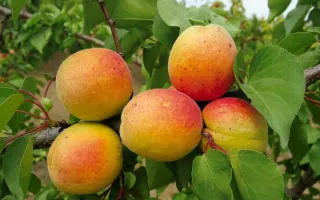
Fruits are densely arranged within the crown and firmly attached to branches. Average fruit weight 26.2 g, maximum 32.4 g, height 38 mm, diameter 36 mm. Shape oval-elongated, tapering to a beak-like tip. Fruit sutures are fine, marked by an intensely colored stripe. Fruit stalk is very short (0.3-0.5 cm), thick. Fruit color bright yellow, covered on the sun-exposed side by a vivid carmine blush, which is accentuated by numerous darker carmine spots. Flesh tender, 'orange-colored from the skin, firm, medium juicy, crisp, refreshing, pleasantly sweet-tart. Contains 12.3% sugar, 2.2% malic acid, 15.4% dry matter. Fruits suitable for fresh consumption and technical processing. Transportability medium. Sensory rating of fruits 3.5 points. Stone completely free, medium size, round, slightly elongated toward the apex, flattened on the sides, surface smooth. Kernel sweet.
Trees enter fruiting stage in the third to fourth year of life. Variety capable of annual fruiting. Commercial yield forms from the fifth year onward. Relatively resistant to moniliosis. Fruit ripening period August 10-15. During rainy periods, fruits do not crack.
Advantages of the variety: resistance to moniliosis and drought. High winter hardiness and annual fruiting capacity.
Disadvantages: frost damage when grown on low-lying areas with high moisture. Insufficient fruit size.
Video · 7 videos
Suggest a video →Crop & resistance
Crop
Disease resistance
Specifications
| Assignment | |
|---|---|
| Flavor | |
| Core | |
| Fetal Size | 3.6 |
| Frost Resistance | |
| Disease Resistance | |
| Transportability | |
| Zoning | |
| Features | |
| Catalog | Catalog → Apricot |
Not yet комментариев. Be the first!
Alternatives
Apricot saplings · similar varieties




See also
Often considered together with this variety


Recently viewed
Products you’ve viewed on this site
Reviews · 0