


SKU #3541
·
799 views
Spartak
Apple
User rating
0 votes0% positive reviews
No ratings yet — be the first.
Type of Sort
Autumn Apple Variety
Prices in stores
from6.64 €per seedling
pack from 6.45 € per pack
2 offers from 2 stores
Store offers · 2 from 2 stores
Prices are updated on loadLoading offers…
Available at: Ilinka Samara · Agromir
Aggregator catalog: prices are collected automatically from store websites, normalized by AI and converted at the current exchange rate. Before ordering, confirm the price and availability on the store's website. This block is not indexed by search engines — the data is loaded after the page opens.
About product

Autumn variety. Developed by S.P. Kedrin at the Samara Experimental Station for Horticulture by selection among seedlings of Sharopay sown in 1936. The presumed paternal variety is Skryzhapель обыкновенный. One of the most widely grown varieties in the Middle Volga region. Registered in the State Register of Breeding Achievements, approved for use in the Middle Volga, Ural, and Eastern Siberian…
Type of Sort
Autumn Apple Variety
Description
Autumn variety. Developed by S.P. Kedrin at the Samara Experimental Station for Horticulture by selection among seedlings of Sharopay sown in 1936. The presumed paternal variety is Skryzhapель обыкновенный. One of the most widely grown varieties in the Middle Volga region.
Registered in the State Register of Breeding Achievements, approved for use in the Middle Volga, Ural, and Eastern Siberian regions.
Trees are medium-sized with a dense, broad-pyramidal crown. Main branches sometimes branch off at sharp angles, leading to breakage. This must be considered when shaping the crown. Shoot-forming ability and bud dormancy are high. Fruit set occurs on all types of fruiting structures, including lateral on long shoots.
Shoots are straight, shiny, brownish-red, with moderate pubescence. Buds are round, whitish, in large quantities. Leaves are elongated-oval, with a narrowed base. Apex is elongated and curled. Leaf blade is positioned at a sharp angle to the shoot, with slight curvature. Texture is significant. Leaf margins are wavy — often, the leaf appears crumpled. Marginal serration is double-toothed and toothed. Pubescence on the underside of the leaf is weak.
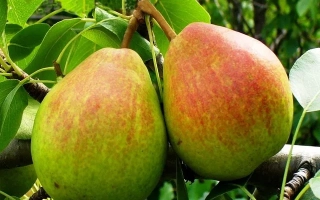
Fruits are medium-sized. Average fruit weight is 90-130 g, and on young trees, fruits weighing up to 300 g are occasionally found. Fruit shape is flat-round or round. Skin is medium-thick, tough, smooth, and shiny. Subcutaneous dots are whitish, small, and weakly expressed. Color is yellowish, initially with a dull striped blush, then transitioning to bright red striped-salmon. This is the best time to harvest fruits. Peduncles are medium-length and thickness, emerging from a wide and deep depression, whose edges often have corky thickening that does not exceed its boundaries. Calyx is medium-sized, closed, located in the middle depth and width of the plate, with gently sloping, smooth walls. Subcalyx tube is wide-conical, not connected to the seed cavity. Seed cavity is medium-sized, bulbous. Chambers are closed or semi-open. Seeds are egg-shaped, light-brown with blunt apex, well-formed. Usually, many seeds are set.
Flesh is creamy, finely textured, tender, medium density, good sour-sweet flavor, suitable for table use.
Harvesting occurs at the end of August or first half of September. Consumption season is from late September to November 15-20, after which flavor quality deteriorates sharply. Fruit quality for both market and consumer use is high.
Best rootstocks in nurseries are seedlings of large-fruited Chinese crabapple and Zhigulevskaya forest apple.
The variety begins fruiting on the 3rd-4th year after the start of growth of the grafted scion, sometimes fruiting is observed even in nurseries on two-year-old plants. Young trees bear fruit annually. The variety is winter-hardy. Resistance of fruits and leaves to scab is moderate.
Advantages of the variety: high fruiting capacity, high fruit quality for both market and consumer use. Belongs to intensive types.
Disadvantages of the variety: susceptibility of fruits and leaves to scab in epidemic years.
Video · 2 videos
Suggest a video →Crop & resistance
Crop
Specifications
| Type of Sort | |
|---|---|
| Catalog | Catalog → Apple |
Not yet комментариев. Be the first!
Alternatives
Apple saplings · similar varieties






See also
Often considered together with this variety






Recently viewed
Products you’ve viewed on this site
Reviews · 0