


SKU #3273
·
539 views
Red Anise (Velvet Anise, Safyan Anise, Red Anise)
Apple
User rating
0 votes0% positive reviews
No ratings yet — be the first.
Type of Sort
Autumn Apple Variety
Tree; Growth Power
Tall
Tree; Canopy Shape
Broad-pyramidal crown
Fruit; Fruit Shape
Flat-round
Prices in stores
from3.07 €per seedling
pack from 7.97 € per pack
3 offers from 3 stores
Store offers · 3 from 3 stores
Prices are updated on loadLoading offers…
Available at: 1sad · AgronomVIP · TK Konstruktor
Aggregator catalog: prices are collected automatically from store websites, normalized by AI and converted at the current exchange rate. Before ordering, confirm the price and availability on the store's website. This block is not indexed by search engines — the data is loaded after the page opens.
About product

Anise varieties are ancient Volga-region autumn-ripening cultivars that, in the past century, occupied the same place in the gardens of the Volga region as Antonovka in the central regions of Russia's middle belt. Anise varieties represent a large family of clones that share many characteristics with each other. Individual anise varieties and forms differ in morphological, biological, and agronom…
Type of Sort
Autumn Apple Variety
Tree; Growth Power
Tall
Tree; Canopy Shape
Broad-pyramidal crown
Fruit; Fruit Shape
Flat-round
Description
Anise varieties are ancient Volga-region autumn-ripening cultivars that, in the past century, occupied the same place in the gardens of the Volga region as Antonovka in the central regions of Russia's middle belt. Anise varieties represent a large family of clones that share many characteristics with each other. Individual anise varieties and forms differ in morphological, biological, and agronomic traits. In the Saratov region, V. K. Levoshin identified 60 varieties of Anise. In the Volgograd and northern parts of the Astrakhan region, V. V. Malychenko discovered 40 different forms that differ in many traits, but primarily in fruit color and ripening time. The main varieties of this cultivar type are Striped Anise, Rose-Striped Anise, and Red Anise.
Red Anise is widely cultivated north and east of the Volga region and is a clone of Striped Anise with brightly colored fruits. It occupies a significant place in the catalog in the Northwest, Volgo-Vyat, and central Volga zones, where it is included in the State Register for these zones. In the Lower Volga region, its percentage has significantly decreased, especially in the Astrakhan region, where it has been replaced by local, early Astrakhan varieties. In the Saratov and Volgograd regions, Rose-Striped Anise is preferred.
Red Anise trees are tall, vigorous, with a wide-pyramidal crown in youth and a spherical, sparse crown when fruiting. Main branches are curved, raised upward, slightly bent, relatively thin, light brown in color. Fruit set is concentrated primarily on spurs and complex ring branches, on three-year-old wood.
Shoots are slightly curved, with short internodes, brown with a reddish tint, and have a small number of rounded, large, but more often medium-sized stipules; shoots are weakly hairy or bare.
Leaves are medium-sized and long, green, rarely oval or egg-shaped, but more often round, with a short tip and rounded base, noticeably curved, slightly folded at the base, finely toothed, lobed or lobed-and-toothed, slightly wavy at the edge. Leaf surface is matte, slightly wrinkled in the middle, with characteristic depressions, about the size of a pea. Leaf petiole is relatively short, strongly hairy, colored with weak anthocyanin without transition to the central vein. Leaf blade hairiness is weak or moderate. Venation is strongly expressed, large netted without anthocyanin coloring. Leaves are arranged at a right angle to the shoots. Stipules are small, lanceolate in shape.
Flowers have white-pink buds, when blooming the flower is medium-sized, cup-shaped, petals white with a greenish tint, elongated-oval, concave, with large waves at the edge, stigma column is relatively short, strongly hairy, style is bare throughout its length, sometimes there is hairiness at the base. Stigmas are positioned slightly above the anthers.
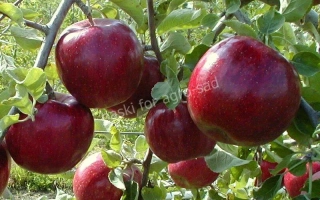
Fruits (Fig.) are medium or slightly smaller, uniform, strongly flattened (often pear-shaped), round or slightly conical to the calyx, slightly ribbed or flat, dry to the touch. Main fruit color is light green, sometimes with a yellowish tint. On most or the entire fruit surface — dense, evenly blurred, dark-red blush. Skin is smooth, densely covered with a waxy coating with a bluish tint, on the colored side of the fruit, medium-sized subcutaneous dots, their average number. They are white, weakly noticeable in the halo, sometimes they have slight (delicate) rusting. Fruit stem is thick, short (in central fruits usually does not protrude beyond the rim of the calyx), in side fruits slightly protrudes from the depression. It is weakly hairy, brown in color. Calyx is closed, medium-sized, fits into a shallow dish with steep edges, narrow, noticeably folded. Subcalyx tube is deep, sometimes medium-depth and width, cylindrical or conical in shape. Axial cavity is small, narrow. Seed cavity is usually located in the center of the fruit or slightly closer to the calyx. Seed chambers are usually closed or slightly open.
Flesh is white, slightly greenish, medium density, juicy, fine-grained, pleasant sour-sweet taste with strong aroma. Chemical composition of fruits: dry matter — 15%, total sugars — 9.6%, titratable acids — 0.65%, on fresh weight, ascorbic acid — 6.1 mg/100g, P-active substances (catechins) — 116 mg/100g, flavonols — 14 mg/100g, total phenolic compounds — 858 mg/100g, pectin substances — 0.71% on fresh weight.
In the Upper Volga region and eastward, fruits ripen in winter, in the Middle Volga region — in autumn, and in the Lower Volga region, this is a summer variety, fruits are harvested at the end of August.
Fruits remain firmly attached to the tree until harvest.
Among other summer varieties, Red Anise fruits stand out for their prolonged storage life (up to one month in a cellar, longer in a refrigerator). Fruit quality is average 79-80%, including top and first grade — 34-36%.
Fruits are consumed fresh and are suitable for processing into juices, jams, pastilles, dried apples and other products.
The variety is self-sterile and requires pollinators, the best of which are Yandikovskoe and July Chernenko.
Trees begin fruiting 4-5 years after planting. They fruit annually. Under full development, they yield 200-300 kg of fruit per tree, then periodic fruiting occurs and fruits become smaller.
Winter hardiness of trees in the Lower Volga region is quite high, however, drought and heat resistance are relatively weak. These characteristics significantly increase when trees of this variety are grown under regular irrigation. The wide distribution of Anise in the Volga region is primarily due to their high ecological adaptability to sharply continental conditions. The variety is relatively resistant to scab and is affected only in years of severe epidemics, scoring 1 point; it is more susceptible to powdery mildew — up to 4 points.
Advantages of the variety: high ecological adaptability, high yield and tree longevity, attractive color, pleasant taste, and fruit transportability, suitability for consumption both fresh and as raw material for processing industries.
Disadvantages of the variety: susceptibility of trees to powdery mildew, relatively small fruit size, and periodic fruiting.
The Red Anise variety is widely used in breeding. Six new varieties have been created using it, including July Chernenko (Red Anise × Papировка) bred at VNIIGiSPR; Daughter Papировка (Red Anise × Papировка) bred at the Samara Fruit Research Station; and Solntsedar (Red Anise — open pollination) bred at the Yekaterinburg Fruit Research Station.
Crop & resistance
Crop
Specifications
| Type of Sort | |
|---|---|
| Tree; Growth Power | |
| Tree; Canopy Shape | |
| Fruit; Fruit Shape | |
| Fruit; Fruit Color (Base Color) | |
| Fruit; Blush (Blush Color) | |
| Catalog | Catalog → Apple |
Not yet комментариев. Be the first!
Alternatives
Apple saplings · similar varieties




See also
Often considered together with this variety



Recently viewed
Products you’ve viewed on this site
Reviews · 0