Agronomic portal Agronom.info
Categories
Language
Currency
My account
Apple

Antonovka Common

Type of Sort
Autumn Apple Variety
Tree; Growth Power
Tall
Cold Resistance
Good winter hardiness
Cultures
Fruit
Offers: 11
Where to buy
Price range
100 - 390 UAH
Views
987
Reviews
0
Producer
Country
Ukraine
Registration Year
1928
Description Antonovka Common
Early winter variety with unknown pedigree, developed by folk selection, gained fame and widespread cultivation in the latter half of the last century and remains the leading variety in the apple assortment of central Russia and Belarus, also regionally adapted in several areas of northern Ukraine and the Volga region. It still accounts for more than half of the commercial production in the central belt of Russia and the northern part of the chernozem zone, despite a decline in its proportion in new plantings due to the emergence of newer, higher-quality winter varieties. Antonovka Common is most effectively cultivated in Oryol, Bryansk, Smolensk, Moscow, Tula, Kaluga, Lipetsk, Tambov, Penza, Ryazan, Kursk, Voronezh regions, and Belarus.

A vigorous tree reaching large dimensions, with an oval (high-spherical) crown that becomes spherical or slightly broader with age. Main branches have brown bark, initially upright, but over time spread outward, well covered with branched ridges, which are the primary sites of fruiting, beginning with three- to four-year-old wood. Fruiting may also occur on two-year-old wood.

Branches with brown bark, curved, usually not straight, angular in cross-section. Leaves are bright green, elongated-ovate (rarely oval) with a rounded base and serrated margins, slightly wrinkled surface, positioned at a right angle to the branch axis on short petioles, with large, lanceolate stipules.
Flowers are fairly large, dish-shaped, white with a slight pinkish tinge, petals elongated and closely appressed, with long, hairless stigmas, the stigmas significantly elevated above the anthers.

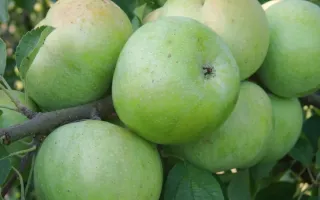
Fruits (see fig.) are medium to above-medium size, fairly uniform, central fruits — round, slightly flattened, side fruits — flattened-round. Many fruits are slightly conical toward the calyx. Ribs are usually visible along the entire length, especially at the edges of the dish. Surface is smooth. Color at harvest is greenish-yellow, turns yellow during storage, without a covering blush or with a very faint, diffuse blush on a smaller portion of the surface if the orchard is under irrigation or under conditions of water deficiency or suboptimal rootstock. Skin is smooth, but in the depth of the calyx cup, and sometimes beyond, corky ("rusty"). Pedicels on central fruits are short and thick, on side fruits — medium or thin, significantly or far protruding from a relatively deep calyx cup. Calyx is closed, nestled in a relatively deep, finely-ridged dish. Subcalyx tube is short, reverse-conical or funnel-shaped. Central cavity is small or not expressed, with seed chambers usually not communicating.
Flesh is yellowish, juicy, sweet-acidic with some excess acidity, which, due to its unique "Antonovskoy" flavor and aroma, not only does not reduce taste quality, but actually (in timely harvested and ripened fruits) enhances it. Ripe fruits emit a very strong, exceptionally attractive aroma, which has contributed to the variety's exceptional popularity. Chemical composition: total sugars — 9.22%, titratable acids — 1.0% on fresh weight, tannins — 41 mg/100g, ascorbic acid — 17 mg/100g (8.3-23.7), P-active substances — 327 mg/100g, pectic substances — 14% (6.7-16.6) on dry weight. Flesh density and storage capacity are higher in fruits from irrigated orchards.
North of the Bryansk-Oryol-Lipetsk-Michurinsk line, the variety is considered winter-hardy; south of this line — late autumn-fruiting. Typical harvest time — mid-September. Storage duration — up to 90 days, up to one month longer after antioxidant treatment. During storage, fruits often develop "sunburn".
Fruits remain firmly attached to the tree until harvest maturity. Under proper packaging conditions, transportability is high. Commercial quality is high — 90-91%, including 13-15% of top-grade fruits and 38-40% of first-grade fruits.
Fruits are consumed fresh and are well-suited for processing: juices, compotes, jams, and for making pastilles and marmalades. Particularly valuable for making cider.
Self-sterile, requires pollinators, among the best are Welles, Anise, Autumn Striped, and Pippin saffron.

Trees begin fruiting at 7-8 years (after budding) and produce commercial yields within 1-2 years. Flowering and fruiting are regular in the first years, then become periodic. Yield potential is high: under normal conditions, average multi-year yields reach up to 200 centners/ha and more. Cases have been recorded where individual trees yielded over 500 and even 1000 kg.
Cold hardiness of Antonovka Common is high, comparable to the most outstanding winter-hardy varieties of domestic apple. The variety is low-maintenance and relatively resistant to diseases. Only during severe epidemics, its susceptibility to scab may increase to average levels.

Advantages of the variety: high ecological adaptability, high yield, high fruit commercial quality, possessing a unique "Antonovskoy" aroma, suitability for fresh consumption, for various processing types and cider production.

Disadvantages of the variety: short fruit storage life, especially in the southern part of the middle zone of horticulture, periodic fruiting.
Antonovka Common proved to be a valuable starting form in the selection of winter-hardy, scab-resistant varieties. Twenty-five varieties have been developed using it, including: Bogatyr (Antonovka x Renet Landsberg) by VNIIGiSPR; Vишневая (Pippin saffron x Antonovka), Druzhba Narodov (Antonovka x Pippin saffron) and Martovskoe (Mekintosh x Antonovka) by VNIIS; Imrus (Antonovka x OR18T13), Orlovim (Antonovka x SR0523), Pamять Voynu (Welles x Antonovka) by VNIISPK.
In the central region of Russia, besides Antonovka Common, other Antonovka varieties (Sweet Antonovka, White Antonovka, One-and-a-half-pound Antonovka) are also encountered. We briefly discuss their origin and characteristics.
Sweet Antonovka. This variety shares the same vegetative origin as Antonovka Common, i.e., it is its clone. Morphologically, the tree and fruit characteristics, winter hardiness, and yield potential of this variety are practically indistinguishable from Antonovka Common. Like Antonovka Common, it tends toward periodic fruiting. It does not differ from Antonovka Common in fruit storability.
Analyses conducted in the biochemical laboratory of VNIISPK showed that Sweet Antonovka fruits contain slightly more sugar than Antonovka Common fruits, and a very small amount of organic acids. The refreshing acidity that is so prized in Antonovka Common is completely absent in Sweet Antonovka fruits.
Fruits of Sweet Antonovka are poorly suited for cider. This variety, like some others, may be of interest only to individual gardeners who prefer bland-sweet fruits. For broad commercial propagation, Sweet Antonovka is not valuable.
White Antonovka. This variety is found in small quantities in old orchards. White Antonovka is not a clone of Antonovka Common. It may be its seedling. White Antonovka produces very attractive large, white fruits, but overall, it significantly lags behind Antonovka Common in terms of useful traits. It is known that White Antonovka trees are less winter-hardy, and fruits are more susceptible to scab and fruit rot, contain more acids, and are less storability. Taste qualities of the fruits are inferior to those of Antonovka Common.
One-and-a-half-pound Antonovka does not differ from White Antonovka in its productive-biological characteristics. Neither of these varieties is of interest for commercial propagation.
Specifications Antonovka Common
Cultures
Fruit
Apple
Type of Sort
Autumn Apple Variety
Tree; Growth Power
Tall
Cold Resistance
Good winter hardiness
Country
Ukraine
Registration Year
1928
Catalog
Varieties
Oilseed Crops
Video Antonovka Common
Loading...
Where to buy Antonovka Common
Loading...
Reviews Antonovka Common
0comments
Sort by:Popular first
No comments yet.