

SKU #3365
·
328 views
Kazanichenskoe
Apple
User rating
1 vote100% positive reviews
No ratings yet — be the first.
Type of Sort
Winter Apple Variety
About product

Late winter, high-quality selection variety of apple from the Dagestan Fruit Tree Experimental Station, obtained by breeders T. B. Alibekov and E. P. Matasova by crossing 'Champagne Renet' with a local Dagestan variety 'Mig-Inc' (Frosty). Widespread in foothill and plain fruit zones of Dagestan. Approved for the foothill zone and northern mountain valley subzone of the mountainous region of the R…
Type of Sort
Winter Apple Variety
Description
Late winter, high-quality selection variety of apple from the Dagestan Fruit Tree Experimental Station, obtained by breeders T. B. Alibekov and E. P. Matasova by crossing 'Champagne Renet' with a local Dagestan variety 'Mig-Inc' (Frosty). Widespread in foothill and plain fruit zones of Dagestan. Approved for the foothill zone and northern mountain valley subzone of the mountainous region of the Republic of Dagestan.
Medium-sized tree, often above medium height, fast-growing, with a rounded and dense crown. Fruits on simple and complex spur branches and fruiting twigs.
Medium-length shoots, thick, straight, slightly curved, brownish-red with a reddish tint. Leaves large, broadly egg-shaped, smooth or slightly wrinkled, with large-veined edges, dark green. Petiole short and thick, stipules small and lance-shaped.
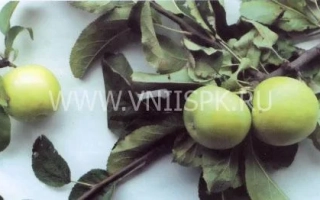
Fruits above medium size (average weight 171-198 g, maximum 360-400 g), flattened, round-conical, often flat-round, fruit surface smooth, slightly ribbed and broadly ribbed. Main color — light yellow or golden-yellow; covering color — mostly medium-expressed, blurred, weakly striped, red. Peduncle short and medium thickness. Calyx above medium size, half-open or often closed. Subcalyx tube wide. Seed chambers above medium size, closed or half-open. Seeds large, broad, egg-shaped, dark brown.
Flesh yellow or light yellow, tender, juicy, slightly acidic-sweet, with a strong spicy aroma, excellent dessert flavor (4.8-5.0 points). Chemical composition of fruit: dry matter — 14.5%, sugar content — 11.7%, titratable acids — 0.69%, ascorbic acid — 13.94 mg/100g.
Late winter variety (fruit harvest 10-15 October) and very long-storing. Storage life and duration of fresh fruit consumption — 200-228 days.
Partially self-fertile, best pollinators — Dagestan Winter, Champagne Renet, Jonathan, Golden Winter Parment.
On strong-growing rootstocks, begins fruiting at 5-6 years; on medium-growing (EM5 and others) — at 3-4 years. High yield (200-327 centners/ha) annually. In Dagestan, sufficiently winter-hardy and resistant to fungal diseases.
Advantages of the variety: high-quality, excellent-tasting fruits, resistance to fungal diseases, early fruiting, high yield, and very long storage life.
Disadvantages of the variety: late vegetative development.
The variety can serve as a donor for early fruiting, high yield, disease resistance, large fruit size, excellent taste quality, and long storage life of fruits.
Crop & resistance
Crop
Disease resistance
Specifications
| Type of Sort | |
|---|---|
| Catalog | Catalog → Apple |
Store offers
Prices are updated on loadLoading offers…
Aggregator catalog: prices are collected automatically from store websites, normalized by AI and converted at the current exchange rate. Before ordering, confirm the price and availability on the store's website. This block is not indexed by search engines — the data is loaded after the page opens.
Not yet комментариев. Be the first!
Alternatives
Apple saplings · similar varieties



See also
Often considered together with this variety




Recently viewed
Products you’ve viewed on this site
Reviews · 0