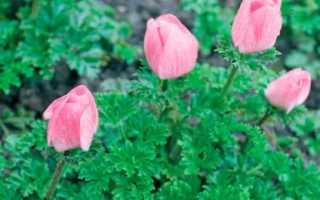
Anemone is a delicate and fragile perennial, valued for its exquisite appearance and variety of varieties. Among the available options, hybrid varieties such as Koenigin Charlotte, Loreley, Margarete, Ouverture, Rotkappchen, Bressingham Glow, Crispa, Garden Breeze Pink Touch, Little Princess, Little White Princess, Pretty Lady Emily, Pretty Lady Julia, Pretty Lady Maria, Wild Swan, Albadura, Hadspen Abundance, Honorine Jobert, Montrose, Richard Ahrens, Ruffled Swan, Serenade, Whirlwind, Bracteata Pleniflora, Robinsoniana, Royal Blue, Vestal, and Virescens can be distinguished. Each of them is distinguished by unique colors, shades, and leaf shape, allowing you to choose the ideal option for any garden.
One of the most popular varieties is the Japanese anemone "Pamina" (Anemone japonica "Pamina"). This hybrid perennial plant reaches a height of 70–80 cm, and the rhizomes form a dense rosette up to 40 cm. Leaves are dark green and pinnately lobed, while small leaves are present on the scape. "Pamina" flowers are double, saucer-shaped with a golden center, deep dark pink, 5–7 cm in diameter. The plant prefers partial shade and grows well in USDA zones 5–9, flowering from late summer to mid-autumn.
Another interesting variety is the forest anemone Polish Star, bred in Poland. This decorative perennial plant is 30–40 cm high with star-shaped green-white flowers that appear in May–June. Polish Star prefers partial shade and fertile, moisture-permeable soils, making it undemanding for growing under the canopy of large trees.
Overall, anemones are versatile plants suitable for creating large masses in a natural garden style, as well as for monocultural compositions. Their delicate flowers and variety of shapes make them a popular choice among gardeners looking to add elegance and naturalness to their landscape.