Introduced by V.A. Molchanov and A.N. Minin at the Samara Botanical Garden and Samara Regional Experimental Station for Horticulture from crossing seedlings of unknown origin No. 12 with seedling No. 5. Popular in amateur gardens in the Samara region and beyond. Approved for the Middle Volga region since 2005.
The tree is relatively tall—up to 5.5 m in height. The crown is round, medium density, well-leafed. Fruiting occurs on multi-year branches. Bark on the trunk and main branches is brownish-gray. Shoots are slender, green with a slight reddish tint on the sunny side. Buds are bare, shiny. Leaves are medium-sized, oval, green, long-pointed, slightly curled at the tip, matte. Leaf blade is slightly concave. Leaf margin is wavy, doubly toothed. Petiole is long, medium thickness, green. Bracts are medium-sized, early-decaying. Stigmas are medium-sized, two, yellow. Inflorescence—large, white flowers. The variety fruits on bouquet branches and spurs.
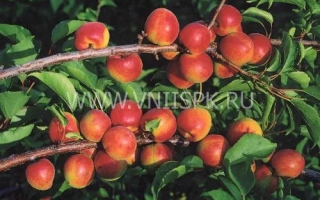
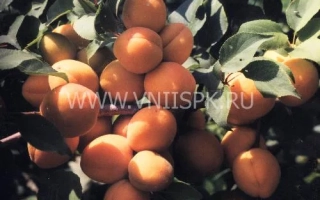
Fruits are medium-sized, one-dimensional, with an average weight of 18-22 g, round shape. Fruit apex is slightly elongated, base with a depression, deep and narrow pit. Fruit sutures are medium depth, prominent. Pedicel is green, medium length and thickness, easy to detach from the branch, weak attachment to the stone. Fruit color is light orange, uniform. No lenticels. Skin is thin, slightly hairy. Flesh is orange-colored, tender, juicy. Juice is colorless. Flavor is tangy-sweet, with a pleasant aroma. Stone is free, large, slightly flattened, weakly wrinkled.
Fruits contain 12.6% dry matter, 7.42% sugars, 2.44% acids, 14.7 mg/100g vitamin C, 3.12 mg/100g carotene, 0.26% pectin. Fruit flavor—4.2 points. Appearance—4.2 points. General purpose variety. Fruits suitable for making jams and compotes.
Harvesting period—July 15-20. Fruits do not hold well on the tree and drop off upon ripening. Harvest fruits slightly underripe, 2-3 days before full ripening. Underripe fruits store for 1-1.5 weeks. Fruit transportability is medium. Fruit quality is high. Fruit transportability is medium.
Flowering period—April 30 to May 2. Fruit ripening is early. Self-sterile. Best pollinators: Kuybyshevsky, Karlik.
Grafted saplings begin fruiting in the 3rd year, and by the 4th year yield marketable crops up to 5 kg. In early years (6-7 years), yield is 7-12 kg per tree; at 12-13 years—14-38 kg. Annual fruiting.
Winter hardiness is high, but lower than that of the Kuybyshevsky Jubilee variety. Susceptibility to bark cracking around the root collar is higher than in the Kuybyshevsky Jubilee variety. The mother tree survived harsh winters of 1968/69 and 1978/79 without significant damage. Drought resistance is high. Moniliosis affects fruits up to 2%. Fruit borers cause damage of no more than 0.3%.
Propagated by grafting onto seedling and clonal rootstocks of early-ripening varieties such as Red Speedy, Kuybyshevsky Ternosly, and other winter-hardy domestic peach varieties, as well as on clonal rootstock OP-15-2. Grows best on light-textured soils on western, south-western, and north-western slopes.
During early growth stages, shaping pruning is required. In full fruiting period, regular pruning is necessary to promote good annual shoot growth, regulate fruit load, and improve fruit quality. In older trees, rejuvenating pruning is required, during which main branches are shortened by 4-5 years of wood. Thinning of inner branches is performed, removing entire branches.
Advantages of the variety: early-ripening, relatively large, tasty fruits.
Disadvantages of the variety: lower winter hardiness of wood and flower buds compared to Kuybyshevsky Jubilee, susceptibility to bark cracking on heavy soils.