
Pepper huasteco yellow vein virus
Begomovirus capsicumhuastecoense
The causative agent of the disease is the Pepper huasteco yellow vein virus (PHYVV), which belongs to the Begomovirus genus within the Geminiviridae family. It is a single-stranded DNA virus known for causing severe damage to solanaceous crops.
What the section contains
Pepper huasteco yellow vein virus
The virus is transmitted exclusively by the whitefly Bemisia tabaci. The insect acquires the virus by feeding on infected plant sap and remains a vector for the duration of its life cycle.
Mechanical transmission via pruning tools or general cultivation practices is not documented. The spread of the disease is entirely dependent on the movement and population density of the whitefly vector.
The viral genome exhibits high recombination rates, allowing it to adapt to different environmental conditions and host resistance levels effectively.
The virus replicates in the plant cell nuclei, disrupting the host's normal physiological functions and leading to the characteristic yellowing and curling symptoms observed in the field.
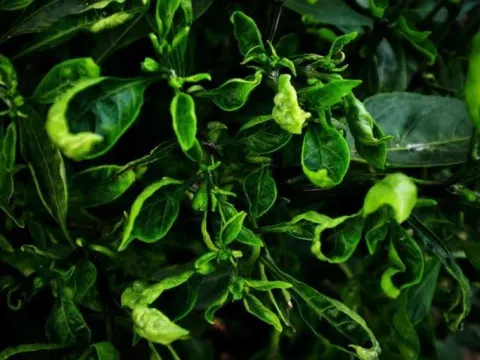
Symptoms initially appear on the upper leaves as vein clearing and yellowing. As the disease progresses, the leaves exhibit chlorosis, curling, and abnormal folding, which is a hallmark of the infection.
Infected plants show severe stunting and reduced internode length. The overall architecture of the plant is stunted, making it appear bushy and weak compared to healthy crops.
Fruit set is severely impaired. Flowers often abscise, and any fruits that do develop are significantly deformed, discolored, and reduced in size, rendering them commercially worthless.
Severe infestations lead to necrosis on the leaf margins and overall plant collapse. The severity of the visual symptoms is strongly correlated with the timing of the initial infection.
In a field setting, infected plants are easily identifiable by their bright yellow mosaic patterns and the severe distortion of the foliage compared to the surrounding healthy plants.
The incidence of the disease is highly correlated with the environmental suitability for Bemisia tabaci populations. Hot, arid climates promote rapid reproduction and migration of the vector.
The primary infection source is often wild solanaceous weeds that harbor both the virus and the whitefly vector. These weeds act as a bridge during the non-growing season.
High-density planting and continuous cropping in greenhouse systems create stable environments where the virus can persist and spread throughout the year without interruption.
Migrations of whitefly populations from neighboring fields are the most critical risk factor during the early establishment phase of the pepper crop.
Lack of spatial isolation and improper management of surrounding vegetation significantly increase the likelihood of widespread infection in commercial pepper fields.
The economic impact of the virus is severe, with potential yield losses reaching up to 100% in susceptible varieties when infection occurs at early growth stages.
Product quality is heavily compromised, making the harvest unacceptable for fresh market sale. This leads to substantial financial loss for growers.
The disease requires intensive management, including heavy chemical applications to suppress vector populations, which increases production costs and environmental impact.
Because there is no curative treatment for infected plants, affected crops must be removed, leading to gaps in the field and further reduction in total output.
The threat of the virus restricts the genetic diversity of cultivars planted in endemic areas, as farmers are forced to stick to specific varieties that show some level of tolerance.
The primary control strategy is the intensive management of whitefly populations through the scheduled application of systemic and contact insecticides to prevent transmission.
Physical barriers such as insect-proof netting in greenhouses are highly recommended to prevent whitefly entry and to minimize the necessity for chemical spraying.
Rigorous weed management is essential. Eliminating solanaceous weeds around the production site reduces the reservoir of both the virus and its insect vectors.
Utilizing certified, virus-free transplants is a vital preventative measure to ensure the crop starts the season without initial infection pressure.
- Monitoring whitefly population levels using sticky traps.
- Rogueing and destroying all symptomatic plants immediately upon detection.
- Implementing effective crop rotation strategies.
- Selecting resistant or tolerant commercial pepper hybrids.