
Pepper leaf curl virus
Begomovirus capsicumbangladeschense
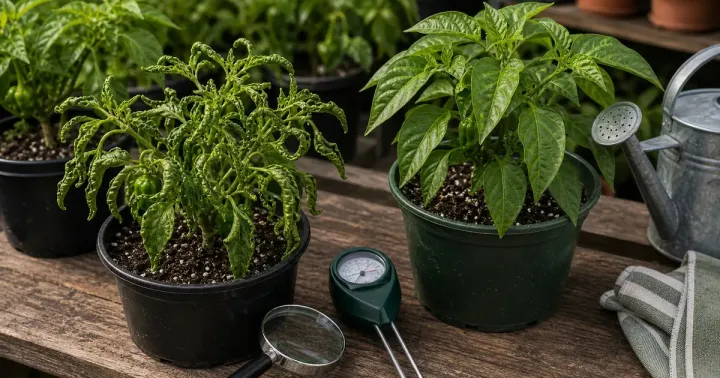
Description
Symptoms
The first and most prominent sign of infection is the curling of apical leaves, accompanied by deformation and reduced leaf size.
Leaf blades become stiff, develop a chlorotic hue, and in advanced stages, exhibit pronounced marginal curling.
Plants infected with this virus show significant growth retardation, with shortened internodes, giving the bush a dwarfed appearance.
If infection occurs at an early developmental stage, flowering may be completely suppressed, or flower buds may drop before opening.
Fruits on infected bushes form in a highly deformed, small, and unmarketable state, significantly reducing the commercial value of the yield.
Pathogen
The Pepper leaf curl virus (a member of the Begomovirus genus) is a significant pathogen affecting plants in the Solanaceae family.
This virus consists of a single-stranded circular DNA structure, transmitted exclusively by specific insect vectors.
It belongs to the geminivirus group, characterized by a complex interaction system with host plant proteins for successful replication within cells.
The pathogen is stable in temperate and tropical climates, making it a severe threat to greenhouse operations and open-field farming in southern regions.
The viral particle exhibits high adaptability, which makes developing fully resistant vegetable varieties an ongoing challenge.
Conditions for development
The primary vector for virus transmission in agricultural settings is the tobacco whitefly (Bemisia tabaci), which transfers the pathogen while feeding on plant sap.
Intensive disease development is observed under high air temperatures and humidity, which favor the reproduction of the vector.
The presence of weeds around fields or greenhouses creates a permanent reservoir of the virus, from which insects migrate to crop plantings.
Virus spread is also accelerated by poor phytosanitary practices, including ignoring quarantine protocols when introducing new seedlings.
The speed of infection across a plantation depends directly on the whitefly population density: higher pest density correlates with faster epidemic spread.
Why it matters
Economic losses caused by Pepper leaf curl virus can reach 80-100% of the total yield in heavily infested areas.
The disease causes total degradation of vegetative organs, forcing the plant's metabolism to shift toward fighting the infection rather than fruit production.
In commercial vegetable production, infested plants must be immediately eradicated to prevent the virus from spreading to adjacent rows.
Long-term survival of the virus in the soil and on alternative hosts requires costly crop rotation adjustments and deep disinfection of greenhouse structures.
The lack of effective curative treatments for already infected plants makes the economic impact of this disease critical for farming enterprises.
Protection
The primary protection strategy involves strict control of whitefly populations using systemic and contact insecticides.
Applying agricultural methods, such as weed removal and the use of protective netting in greenhouses, significantly reduces infection risks.
It is recommended to plant only resistant or tolerant pepper hybrids that have been tested for susceptibility to this specific virus type.
A crucial element of prevention is the use of healthy, certified planting material and compliance with quarantine rules when importing seedlings.
- Regular monitoring of plantations for whitefly infestations
- Use of light and yellow sticky traps
- Timely rogueing and destruction of infected plants
- Maintenance of spatial isolation between young and old plantings
Discussion
No discussions yet — be the first.