
Pepper curly top virus
Begomovirus capsicumchinaense
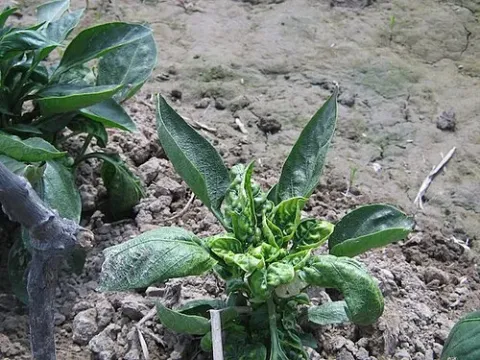
The first and most noticeable symptom of plant infection is a sharp slowdown in the growth of the apical part of the shoots. Leaves in the upper area of the bush begin to deform, acquiring a characteristic curly and wrinkled appearance.
What the section contains
Pepper curly top virus
Chlorosis is frequently observed on leaf blades, manifesting as yellowing of tissues between veins or along them. The affected leaves become brittle and may curl inward or outward, giving the plant a "fan" or "bushy" appearance.
Flower stalks often develop poorly under the influence of the virus, leading to massive shedding of buds and ovaries. If fruits do form, they have abnormal shapes, reduced sizes, and often lose their commercial appeal due to spotting.
The root system of the affected plants also suffers secondarily because the cessation of assimilates flowing from leaves to roots essentially halts bush development. In advanced cases, the plant completely stops vegetation and dies.
A characteristic sign is the systemic nature of the virus spread within the plant, where the infection quickly covers all organs from the growth point to the lower tiers.
The causative agent of the disease is a virus from the Begomovirus group, belonging to the Geminiviridae family. These are small single-stranded DNA viruses with a specific geminate virion structure.
The virus is an obligate parasite that cannot survive in the external environment without a living host or vector. Its transmission is primarily carried out by insect vectors during feeding on plant tissues.
The main vector of the pathogen under natural conditions is the tobacco whitefly (Bemisia tabaci). The virus is acquired by the insect while feeding on an infected plant and transmitted to healthy individuals via a circulative mechanism.
Mechanical transmission of the virus through sap during pruning or plant care is limited, which is why the main survival strategy of the virus is persistence within the insect vector.
The virus's genetic apparatus allows it to quickly adapt to environmental conditions and actively replicate in host cells, taking control of the plant's metabolism.
The development of epiphytotics depends directly on the population size of the tobacco whitefly in the area. The most active spread of the virus is observed during periods of drought and high air temperatures.
Hot weather promotes the accelerated reproduction of whiteflies, leading to a sharp spike in the number of infected individuals in pepper fields. In greenhouse conditions, disease outbreaks can occur year-round if an infection source is present.
The presence of weeds around fields or greenhouses plays a critical role in preserving the virus during the off-season. Many weed species serve as natural reservoirs for the pathogen.
Insufficient agronomic practices, including a lack of weed control, create ideal conditions for the accumulation of viral load. The migration of winged whitefly forms from adjacent plots can lead to the infection of an entire field in a matter of days.
Optimal conditions for virus expression in plant tissues are a temperature range of +25...+30 degrees Celsius and sufficient lighting that activates metabolic processes.
The damage caused by the Pepper curly top virus is critical, as there are currently no effective treatments for already infected plants. Yield on affected plots can drop by 80–100%.
The disease leads to significant economic losses, as the affected fruits cannot be sold fresh due to their deformation and poor taste qualities.
Infected plants become weak and susceptible to a complex of other pathogens, including fungal and bacterial infections that develop against the background of the crop's generally suppressed immunity.
The virus poses a threat not only to industrial production but also to breeding programs, as the destruction of varietal material incurs long-term losses for agricultural enterprises.
The prolonged presence of the virus in the agroecosystem creates a constant risk for subsequent crop rotations, especially if other susceptible nightshade crops are included.
The primary control method is a comprehensive protection system against the vector — the tobacco whitefly. The use of systemic insecticides allows for the significant restriction of insect spread.
- Using yellow sticky traps to monitor whitefly populations.
- Spatial isolation of new plantings from older, already infected plots.
- Elimination of weeds that can act as intermediate hosts for the virus.
- Application of non-woven covering materials to protect young plants during their period of maximum vulnerability.
- Adherence to crop rotation rules and the use of virus-resistant pepper varieties and hybrids.
Biological control methods include the use of entomophages, such as Encarsia or predatory bugs, which help to suppress whitefly populations in closed-ground conditions.
It is important to regularly disinfect tools and containers used for plant care, although the risk of mechanical transmission of the virus remains relatively low.
Upon detection of the first signs of the disease, it is recommended to immediately remove and destroy affected bushes by burning to prevent further spread of the infection to healthy plants.