
Pepper leaf curl virus
Begomovirus capsivellanadense
The causative agent of the disease is Begomovirus capsivellanadense, a virus within the Geminiviridae family.
What the section contains
Pepper leaf curl virus
The virus is primarily transmitted by the silverleaf whitefly (Bemisia tabaci) in a persistent circulative manner.
The pathogen utilizes the host's cellular machinery to replicate its single-stranded circular DNA genome.
Once introduced into the plant, the virus moves through the phloem to systematically infect all parts of the organism.
Due to its high mutation rate, this virus poses a constant threat to modern pepper breeding programs.
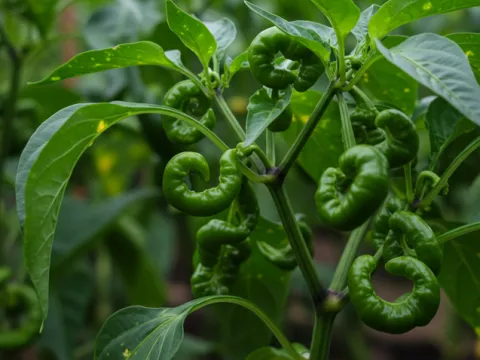
The most distinctive symptom is the downward or upward curling of the leaves, accompanied by reduced leaf size.
Infected plants exhibit severe stunting, with shortened internodes leading to a bushy, rosette-like appearance.
Leaf tissues often display chlorosis, vein clearing, and mosaic patterns due to disruptions in nutrient transport.
Fruit set is significantly reduced, and the resulting peppers are often distorted, small, and of poor commercial quality.
- leaf curling and severe distortion;
- stunted plant growth and shortened internodes;
- chlorosis and yellow mottling of foliage;
- drastic reduction in fruit production.
The spread of the virus is heavily dependent on the population density of its whitefly vector in the area.
High temperatures and moderate humidity levels are optimal for the rapid multiplication of the whitefly population.
Weedy fields serve as reservoirs for the virus, allowing it to persist during periods between crop cycles.
Monoculture farming practices provide a continuous supply of hosts, accelerating the epidemiological cycle.
Lack of proper sanitation in greenhouses allows the virus to survive and persist across consecutive seasons.
Pepper leaf curl virus is highly destructive, capable of causing total crop failure in highly susceptible pepper varieties.
Economic losses arise from both the reduction in marketable yield and the increased costs of pest management.
The systemic nature of the infection makes it impossible to cure plants once they are symptomatic.
Early-stage infection leads to irreversible developmental failure, resulting in zero economic return from those plants.
Trade restrictions and phytosanitary controls may be imposed on regions where this virus is prevalent.
Integrated Pest Management (IPM) focusing on whitefly suppression is the primary strategy for limiting disease spread.
Using certified, virus-free transplants is critical for preventing the early introduction of the pathogen into fields.
Implementing physical barriers like fine-mesh insect nets in greenhouses effectively excludes vectors.
Aggressive weed management in and around production sites reduces the potential reservoirs for both the virus and vectors.
Selecting and planting tolerant or resistant commercial hybrids is the most sustainable approach for long-term protection.