
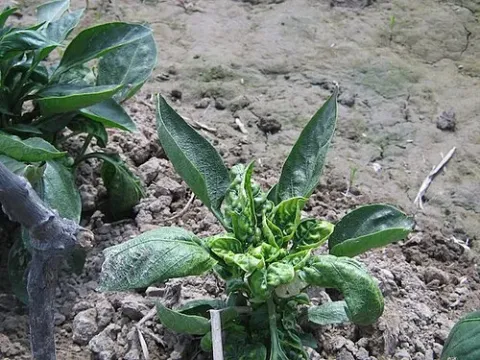
Pepper curly top virus
Begomovirus capsicumyunnanense
The causative agent of this disease is the Begomovirus capsicumyunnanense, a member of the Begomovirus genus within the Geminiviridae family. It is a plant virus featuring a single-stranded circular DNA genome.
What the section contains
Pepper curly top virus
This virus specifically targets solanaceous crops. It is not transmitted by mechanical contact or contaminated tools, but is strictly transmitted by the sweetpotato whitefly (Bemisia tabaci) in a persistent, circulative manner.
The virus replicates within the phloem tissue of the host plant. Once the whitefly acquires the virus through feeding, it remains infectious for the rest of its lifespan, facilitating rapid transmission in dense planting conditions.
Biological studies show that the virus induces physiological changes that interfere with the plant's hormonal balance, specifically impacting the auxin and cytokinin levels which regulate growth.
There are no known chemical cures for infected plants. Once the viral DNA is integrated into the plant cells, the infection persists until the plant dies or is removed.
Symptoms typically appear on the youngest leaves of the plant. The leaf margins curl upward or downward, and the leaf tissue becomes thick, leathery, and wrinkled.
Chlorosis, or yellowing, often develops along the veins, creating a distinctive mosaic pattern. This indicates that the virus is interfering with the production of chlorophyll.
The entire plant exhibits stunted growth. Internodes become shortened, leading to a compact, rosette-like appearance of the terminal shoots, which is a classic diagnostic marker.
Flowering is severely affected. Infected plants often produce fewer buds, and those that do form are often distorted or abscise prematurely before opening.
Fruit development is significantly stunted. Any fruit that reaches maturity is usually small, misshapen, and commercially unacceptable due to poor quality and taste.
The spread of the virus is inextricably linked to the population dynamics of the whitefly vector. Warm and dry climates provide optimal conditions for rapid whitefly breeding.
Greenhouses and tunnels are high-risk environments. Poor ventilation and high ambient temperatures inside these structures promote the migration of whiteflies between host plants.
Weeds in the nightshade family surrounding the production site act as primary reservoirs, allowing the virus to persist between growing seasons and during the winter months.
High-density planting increases the frequency of whitefly interaction with healthy plants, leading to an exponential increase in the number of infected individuals in a short period.
Movement of infested nursery seedlings from one region to another is a primary cause of long-distance spread, introducing the virus into previously uninfected areas.
The primary economic impact is the total loss of marketable yield in infected sections of the field. Infected plants cannot be "saved" or restored to productivity.
The cost of aggressive vector control significantly increases the production budget. Frequent insecticide applications are required, which can lead to whitefly resistance over time.
The plant's overall health is severely compromised, making it susceptible to secondary infections like fungal wilts, which further complicate crop management.
In large-scale production, the presence of the virus can necessitate the destruction of entire rows or sections of the greenhouse to stop the spread, causing massive revenue losses.
The reduction in quality makes the produce unsuitable for fresh markets, forcing growers to discard significant amounts of fruit that fail to meet grading standards.
Successful management relies primarily on the control of the whitefly population. Implementing a strict insecticide rotation program is essential to manage vector numbers effectively.
- Screening greenhouse openings with fine-mesh insect nets to exclude whiteflies.
- Using yellow sticky traps to monitor and reduce the local whitefly population.
- Strict sanitation measures, including the removal and destruction of all infected host plants.
- Controlling weeds in and around the greenhouse to eliminate reservoir hosts.
- Sourcing healthy, virus-free transplants from certified, reliable nurseries.
Cultural practices, such as deep cleaning of greenhouses between production cycles, are crucial to ensure that no dormant vectors or viral reservoirs remain in the facility.
Integrated Pest Management (IPM) strategies, including the introduction of natural predators (like Encarsia formosa), can provide supplemental control for whiteflies in enclosed environments.