
Pepper Lahore begomovirus
Begomovirus capsicumlahorense
Description
Symptoms
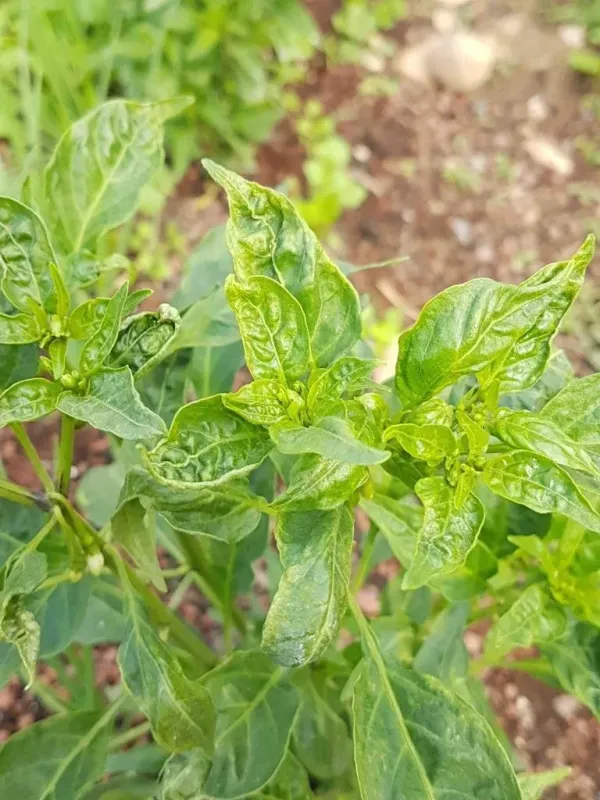
The primary symptom of Pepper Lahore begomovirus infection is pronounced leaf mosaic, accompanied by severe leaf deformation and curling. Affected plants exhibit stunted growth and shortened internodes, giving the shrub a dense, "brush-like" appearance.
Leaf blades develop uneven chlorotic patterns, with yellowing often occurring along the veins. In advanced cases, leaves become brittle, and their margins curl inwards or outwards, significantly impairing the plant's photosynthetic capacity.
Flower buds may drop prematurely, or if fruit does develop, it is often stunted and malformed, making it unmarketable. The overall decline in plant immunity leaves it susceptible to opportunistic fungal and bacterial pathogens.
Diagnosing this disease is complex, as symptoms often mimic nutrient deficiencies or damage caused by spider mites. Molecular genetic techniques, particularly PCR, are required for accurate viral identification and confirmation.
Symptom severity varies depending on the age of the plant at the time of infection and specific varietal susceptibility. The most distinct signs are typically found on young apical shoots, which respond rapidly to the systemic virus spread.
Pathogen
The causative agent is a virus belonging to the genus Begomovirus, within the Geminiviridae family. It features a single-stranded circular DNA genome enclosed in characteristic geminate (paired) virions.
The main natural reservoirs of the virus are wild weed species in the Solanaceae family, which may remain asymptomatic. Unlike many other plant viruses, this pathogen is not transmitted mechanically through sap during pruning or handling.
The primary and most efficient vector for this begomovirus is the tobacco whitefly Bemisia tabaci (biotype B or MEAM1). Once the whitefly acquires the virus by feeding on an infected host, it remains a vector for the duration of its lifespan.
Viral circulation within the whitefly follows a persistent circulative pathway: virions are ingested, pass into the hemolymph, and eventually reach the salivary glands. A latent period is required before the insect can successfully transmit the virus to healthy plants.
Experts highlight the high adaptive capacity of this pathogen to diverse ecological niches. The virus efficiently replicates within the phloem tissues of the host, hijacking plant cellular resources to synthesize its own viral proteins and nucleic acids.
Conditions for development
Disease prevalence is directly correlated with the population dynamics of the tobacco whitefly. Hot, dry weather conditions accelerate the insect's reproductive cycle, leading to dramatic population surges and increased risk of viral outbreaks.
The existence of a "green bridge"—where pepper crops are grown continuously without breaks—provides an ideal environment for the virus to survive and spread. This allows the whitefly population to maintain a constant supply of viral inoculum.
Insufficient spatial isolation between nursery operations and commercial greenhouses contributes to early-stage viral introduction. Whiteflies easily migrate from peripheral weeds into greenhouses seeking more succulent host tissue.
In protected cultivation, high humidity levels and the frequent absence of natural predatory insects create a perfect breeding ground for whiteflies. Poor sanitation practices regarding equipment and containers also facilitate the spread of the virus.
Heavy reliance on broad-spectrum insecticides can unintentionally kill natural enemies of the whitefly, leading to a rebound in pest populations and an accelerated secondary spread of the virus.
Why it matters
The economic impact of this begomovirus is primarily due to the total or partial loss of crop marketability. Infected plants cannot support proper fruit development, resulting in drastically lower yield volume and individual fruit quality.
The virus often triggers early flower and fruit abortion, leading to yield losses of up to 80–100% in severely affected plots. Plants infected early in the season often fail to produce any marketable fruit whatsoever.
Financially, managing this disease is extremely burdensome due to the constant need for intensive whitefly control measures. Any produce showing visual deformation is rejected at grading, adding to the financial burden on the grower.
Because the virus can persist in soil-borne crop residues and weeds, farmers are often forced to invest in costly phytosanitary clean-ups. Operations facing recurring outbreaks may need to switch crop specializations or use expensive resistant varieties.
Beyond direct financial losses, the disease damages the producer's reputation, as it becomes impossible to guarantee a consistent supply of premium-quality produce. Because the disease is systemic, no curative treatment exists once a plant is infected.
Protection
The cornerstone of disease management is strict control of tobacco whitefly populations. The use of yellow sticky traps is essential for monitoring pest levels and timing chemical interventions effectively.
Maintaining strict spatial isolation between pepper crops and other susceptible hosts, such as melons or tomatoes, is crucial. Eliminating weed hosts around the perimeter of the field significantly reduces the environmental viral reservoir.
Installing fine-mesh exclusion screens on greenhouse vents is a highly effective way to prevent whitefly entry. It is equally important to use only certified disease-free seedlings raised in secured facilities.
Agrotechnical strategies include crop rotation with non-host species and implementing a strict "fallow" period for greenhouses. Early detection and immediate rogueing of the first symptomatic plants can significantly slow the progression of the epidemic.
- Utilizing biological control agents, such as the entomopathogenic fungus Beauveria bassiana.
- Planting resistant or tolerant hybrids developed through modern breeding programs.
- Rotating different insecticide classes to mitigate the risk of pest resistance development.
Discussion
No discussions yet — be the first.