
Pepper leaf curl virus
Begomovirus capsicumcontorsioris
Description
Symptoms
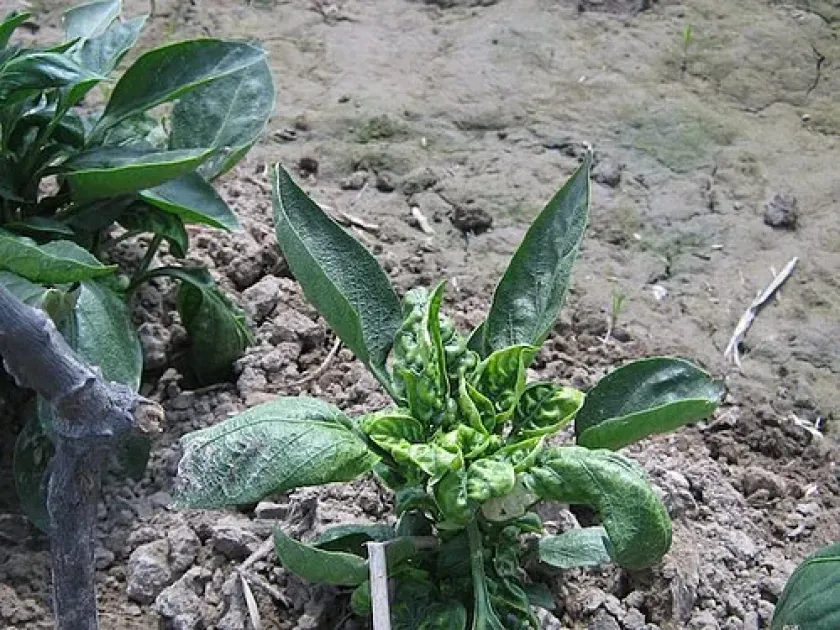
The first and most prominent symptom of infection is a characteristic curling of the leaf blades, either upwards or downwards. Leaves become rigid, develop a leathery texture, and undergo severe deformation.
Pronounced chlorotic spotting is observed, which eventually progresses into a mosaic pattern. Leaf tissues lose their natural coloration, turning pale yellow or light green as the infection inhibits normal chlorophyll production.
Plants infected at early growth stages exhibit significant stunting and developmental delays. Internodes become shortened, causing the plant to develop a dwarf, bushy habit with excessively dense and distorted top foliage.
Flowering is significantly impaired or ceases entirely upon infection. Even if fruit set occurs, the peppers are often deformed, undersized, and lack market value, rendering the harvest commercially unviable.
- Yellowing of veins on young leaves.
- Severe curling of terminal shoots.
- Abscission of flower buds and immature fruit.
- Loss of turgor pressure not caused by water deficiency.
Pathogen
The causative agent of the disease is a virus belonging to the genus Begomovirus, which is part of the Geminiviridae family. This pathogen contains a single-stranded circular DNA genome, characterized by a high mutation rate and rapid adaptation to changing environmental conditions.
The disease type is a systemic viral infection that affects the entire plant organism. The virus colonizes the phloem cells, disrupting the normal transport of nutrients and metabolic products from the leaves to the fruit and root systems.
Primary natural reservoirs of the virus include various weed species within the Solanaceae family, which harbor the infection throughout the winter season. Additionally, the virus can be transmitted through seed material, although the primary mode of transmission is vector-based.
The primary vectors of the virus are whiteflies (specifically Bemisia tabaci). During the feeding process, an infected whitefly injects viral particles directly into the leaf tissue, facilitating rapid transmission and colonization of the host plant.
Unlike fungal diseases, pepper leaf curl virus cannot be cured with fungicides. Management requires an integrated approach focusing on vector eradication and establishing physical or chemical barriers to prevent virion spread.
Conditions for development
Disease development is closely linked to whitefly population dynamics. The most intense viral spread occurs during dry and hot weather, which facilitates the rapid proliferation of insect vectors.
High ambient temperatures (exceeding +25... +30°C) accelerate the whitefly lifecycle and increase the replication rate of the virus within plant cells. In greenhouse environments, these factors act with increased severity.
Poor agricultural practices, such as high-density planting and inadequate ventilation, create an ideal microclimate for pest multiplication. Under these conditions, the virus can spread across an entire greenhouse within a few weeks.
Lack of weed management around production sites promotes a constant influx of infected insect vectors. Weeds serve as a bridge, transferring the virus from wild flora to cultivated crops.
Light intensity also plays a crucial role; shaded conditions make plants more susceptible to viral infections due to compromised immune responses. A healthy, actively photosynthesizing plant is better equipped to resist pathogen colonization.
Why it matters
Pepper leaf curl virus causes substantial economic losses for the agricultural sector. Infected plants often cease fruit production entirely, resulting in yield losses ranging from 50% to 100%.
Damaged produce loses both aesthetic appeal and physical quality. Deformed and undersized peppers cannot be sold on the fresh market, which results in a complete loss of investment in fertilizers, water, and labor.
The virus is a persistent pathogen that is difficult to eliminate. If the disease spreads significantly, the only effective method to prevent an epidemic is the complete removal and destruction of infected plants, including their root systems.
Because the virus spreads rapidly, a single infected plant in a greenhouse can serve as the source of total crop failure within a short period. This forces producers to use aggressive vector control methods, thereby increasing production costs.
Long-term harm includes the potential for viral persistence in the environment, making subsequent planting seasons in infected areas high-risk and necessitating extended fallow periods or the use of resistant varieties.
Protection
The primary control strategy involves strict management of insect vectors. The application of systemic insecticides against whiteflies helps reduce the probability of initial infection during the early stages of plant development.
It is essential to strictly adhere to phytosanitary regulations: use only certified, high-quality seed material and ensure the regular disinfection of tools that could transmit sap from infected plants to healthy ones.
An important preventive step is the eradication of all weed hosts in and around greenhouses. Installing fine-mesh protective screens on ventilation openings effectively prevents pests from entering the growing environment.
Implementing resistant pepper varieties and hybrids with genetic tolerance to begomoviruses is recommended. Breeding for resistance remains the most reliable long-term strategy for managing the disease.
Constant crop monitoring using yellow sticky traps helps detect the arrival of the first insect vectors. Rapid response and the immediate removal of symptomatic plants help localize infection outbreaks before they spread throughout the plantation.
Discussion
No discussions yet — be the first.