

Disease · fungal · affects Common sunflower, Gerbera jamesonii, Indian mustard
White rust
Albugo tragopogonis
Description
Symptoms
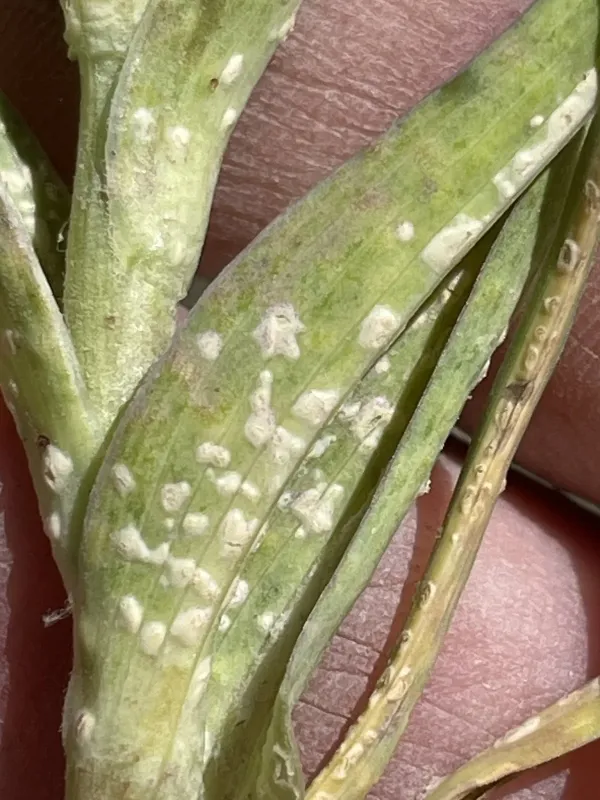
The primary symptom is the appearance of white, raised, powdery pustules, which are clusters of sporangia that break through the plant epidermis.
Pustules are typically found on the undersides of leaves, but under severe infection, they can also appear on stems, petioles, and floral parts.
Infected plant parts often exhibit significant deformation, such as curling of the leaves, twisting of the stems, and hypertrophy (swelling) of the tissues.
Yellowish chlorotic spots often develop on the upper surface of the leaves, corresponding to the locations of the pustules on the lower surface.
Severe infections lead to rapid leaf senescence, drying of the foliage, and significant reduction in photosynthetic capacity, which weakens the entire plant.
Pathogen
The causal agent of white rust is Albugo tragopogonis, which is classified as an oomycete, not a true rust fungus. It is an obligate parasite that requires a living host to survive and complete its life cycle.
The pathogen reproduces by forming zoosporangia, which release motile zoospores. These spores are highly dependent on water for movement and infection of host plant tissues.
The life cycle includes the formation of oospores, which are thick-walled sexual spores that can survive in the soil or plant debris for several years.
The mycelium of the pathogen grows intercellularly within the host tissue, extracting nutrients through specialized structures called haustoria.
This pathogen has a wide host range, infecting various crops including Indian mustard, Gerbera jamesonii, sunflower, Jerusalem artichoke, sweet potato, and spinach.
Conditions for development
White rust development is favored by cool, wet weather conditions, with temperatures typically ranging between 15 and 20 degrees Celsius.
High relative humidity and the presence of free water on plant surfaces, such as dew, rain, or fog, are essential for spore germination and infection.
Poor ventilation, whether in field conditions with high planting density or in greenhouses, significantly increases the likelihood of a disease outbreak.
The pathogen is easily disseminated by splashing water, wind currents, and even insects or tools that come into contact with the spores.
Overhead irrigation systems can create the necessary moisture conditions for the rapid spread of the disease if managed incorrectly.
Why it matters
White rust causes major economic losses by reducing the quality and yield of the harvest, particularly in leafy greens like spinach where leaves become unmarketable.
For oilseed crops like sunflowers, the disease impairs the plant's ability to fill seeds effectively, resulting in lower oil content and overall weight.
The disease reduces the plant's vigor, making it more susceptible to opportunistic secondary infections by bacteria or other fungi.
In ornamental crops like gerbera, the disfigurement caused by white rust significantly lowers the commercial value and aesthetic appeal of the flowers.
If left uncontrolled in favorable conditions, the disease can spread rapidly throughout a crop, causing massive defoliation and yield failure.
Protection
Crop rotation is the most critical cultural practice, as it helps break the life cycle of the oomycete by removing the host for several seasons.
Sanitation practices, such as the removal and deep incorporation of crop residues, are vital to eliminate the primary sources of overwintering inoculum.
Using certified, disease-free seed and selecting resistant cultivars are primary defense strategies for managing white rust in large-scale agriculture.
Fungicides specifically targeted at oomycetes (such as metalaxyl or other systemic compounds) are effective for chemical control when applied at the early onset of symptoms.
Optimizing greenhouse management by controlling humidity and using drip irrigation helps minimize the conditions required for pathogen spread.
In brief
6
Affects crops
Biology
Pathogens and affected parts
Pathogens
Affected plant parts
whole plant
Content graph
Affects crops · 6
Content graph
Connections · White rust
Most often together:
Marketplace
Products · 5
Community
Discussion
No discussions yet — be the first.