
Description
Symptoms
The first signs of apple rust appear in late spring or early summer as bright yellow or orange spots on the upper surface of the leaves.
Over time, small dark dots develop within these spots, while on the underside of the leaves, characteristic blister-like or conical growths begin to form.
During the sporulation stage, the underside of the leaf becomes covered with a powdery spore mass, which can be easily transported by wind over long distances.
In cases of severe infection, affected leaves turn yellow, curl, and drop prematurely, which disrupts the tree's ability to photosynthesize effectively.
Symptoms also manifest on the fruit, where orange-colored lesions appear, causing deformation and rendering the apples unsuitable for fresh consumption or storage.
Pathogen
The causal agent of this disease is the fungus Gymnosporangium globosum, which belongs to the group of rust fungi. This is an obligate parasite that requires two different hosts to complete its complex biological life cycle.
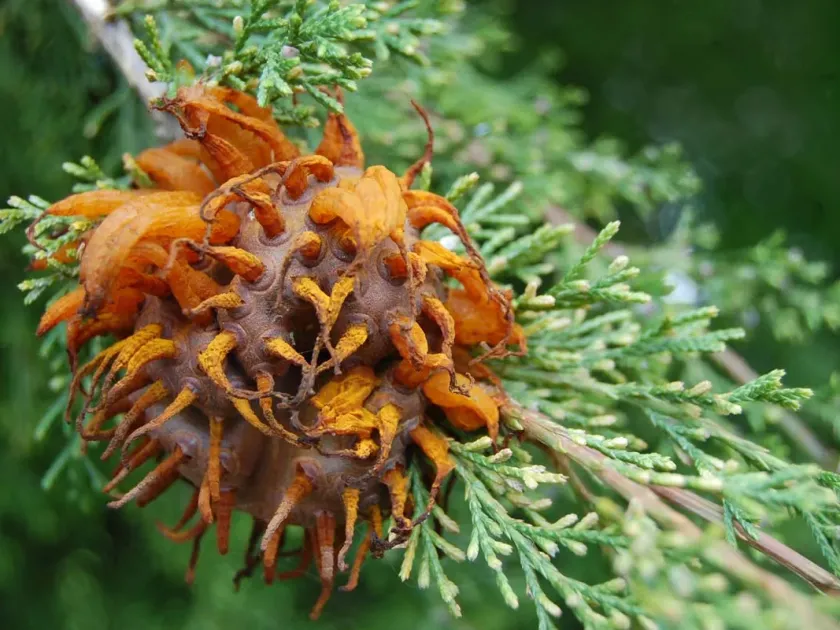
The primary alternate host for this fungus is the juniper, where the pathogen spends the winter as mycelium within the branches. In spring, orange galls form on infected junipers, which swell after rainfall to release fungal spores.
The apple tree serves as the main host during the summer season. Spores carried by the wind from nearby junipers land on apple leaves, fruits, and young shoots, initiating the infection process.
The fungus is highly adaptable to various temperate climates, allowing it to persist in orchards for many years if sanitation measures are ignored.
This disease is classified as a mycosis, affecting the epidermis and parenchyma of leaves. Without proper management, the fungus can significantly weaken the tree's overall vigor and physiological health.
Conditions for development
High humidity and frequent rainfall during the spring are crucial for the development of the disease, as spores require moisture to germinate and infect the host tissue.
Optimal temperatures for the spread of the fungus range from 15 to 22 degrees Celsius, which often coincides with the critical stage of new leaf development in apple trees.
The proximity of juniper bushes within a few hundred meters is the primary risk factor, acting as a constant reservoir for the inoculum in the area.
Poor orchard sanitation, such as dense tree planting and lack of pruning, creates a humid microclimate that significantly accelerates fungal development.
Weakened trees, suffering from nutrient deficiencies or pest infestations, are significantly more susceptible to infection and exhibit faster symptom progression.
Why it matters
The primary damage from apple rust is the loss of leaf area, which leads to a dramatic decrease in the tree's overall metabolic activity and stored energy reserves.
Premature leaf drop prevents the tree from properly preparing for winter dormancy, leading to increased susceptibility to cold damage and frost injury.
Infected fruits lose their marketability and quality, causing direct financial losses for the grower due to reduced yields and inferior produce.
Chronic rust infections weaken the tree's immune response, making it more vulnerable to other secondary pathogens like apple scab or black rot.
If left untreated over several seasons, the cumulative stress causes stunted growth and a significant reduction in the formation of fruit buds for the following year.
Protection
The most effective strategy is spatial isolation: removing juniper bushes from the vicinity of the orchard or selecting rust-resistant apple cultivars.
Fungicide applications, particularly those containing copper, are essential for suppressing spore germination and protecting new foliage during high-risk periods.
Proper orchard management, including regular pruning to improve airflow and reduce canopy humidity, is vital for long-term disease prevention.
- Preventive spraying before the flowering period;
- Use of systemic fungicides upon the first sign of infection;
- Thorough collection and disposal of fallen leaves in autumn;
- Balanced application of potassium and phosphorus fertilizers for tree health.
Routine monitoring of the orchard allows for early detection of the pathogen, enabling timely intervention before the infection reaches epidemic proportions.
Pathogens and affected parts
Affects crops · 1
Discussion
No discussions yet — be the first.