
Description
Symptoms
The most characteristic sign of the infection is the softening of tissues, which quickly turn into a pulpy, foul-smelling mass. The rot typically starts in the lower parts of the plant and spreads rapidly upwards.
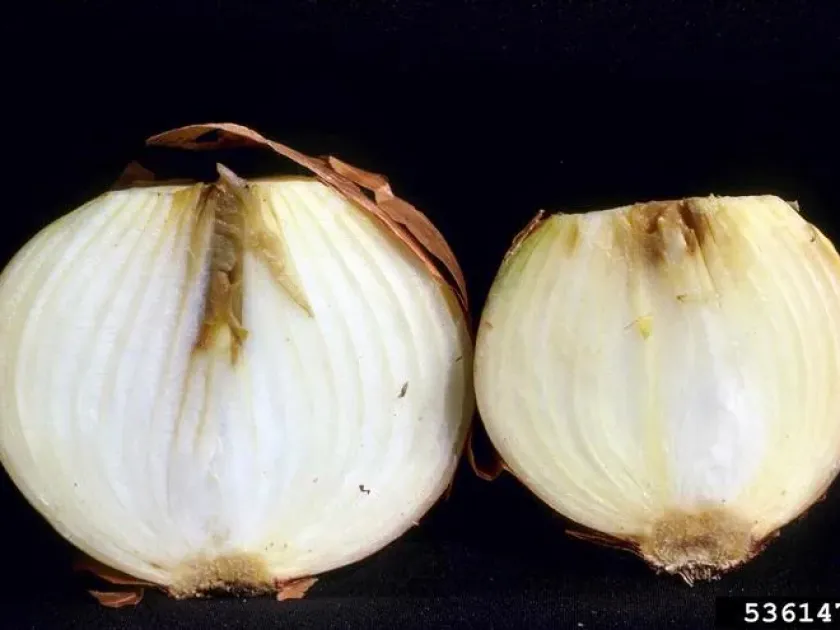
In onions and garlic, the disease often manifests as the softening of the basal plate. As the infection progresses, the internal scales of the bulb become water-soaked, discolored, and eventually turn into a mushy liquid.
Above-ground symptoms include yellowing and premature wilting of the leaves. Infected plants often show a weak root system, and the plants can be easily pulled from the soil due to the decay of the basal structures.
Stem-based crops may exhibit vascular darkening and necrosis. This blockage of the vascular system prevents nutrient and water transport, causing sudden collapse of the stems and foliage.
Under conditions of high relative humidity, a bacterial ooze may appear on the surface of the infected areas. This exudate contains high concentrations of bacteria, which can be easily spread by water splashes or contact.
Pathogen
The causal agent of this disease is the Gram-negative bacterium Dickeya chrysanthemi, formerly classified as Erwinia chrysanthemi. It is a highly aggressive facultative parasite that utilizes complex enzyme systems to degrade plant cell walls.
This pathogen effectively thrives in intercellular spaces, secreting pectinolytic enzymes that dissolve the middle lamella of cell walls, resulting in rapid tissue liquefaction. It can persist in soil, plant debris, and infected vegetative propagation material.
The bacterium has a very broad host range. Among the most economically significant crops affected are onions, garlic, potatoes, and various ornamental plants, making it a major concern for global agricultural production.
Transmission occurs through contaminated farming equipment, irrigation water, and direct contact between healthy and diseased tissues. The presence of flagella allows the bacterium to be motile, facilitating its rapid movement into plant tissues.
The life cycle of Dickeya chrysanthemi is heavily dependent on moisture. Since the bacterium requires a film of water to move and initiate infection, high humidity is essential for the disease to reach epidemic proportions.
Conditions for development
The development of the disease is highly favored by warm temperatures, typically ranging from 25 to 30 degrees Celsius. These conditions coincide with peak bacterial metabolic activity and rapid reproduction rates.
Excessive soil moisture caused by over-irrigation or persistent rainfall is a primary driver of disease outbreaks. Poor drainage on the field promotes the survival and dispersal of the pathogen.
Mechanical injuries caused by insect pests serve as entry points for the bacteria. Furthermore, insects often act as vectors, transporting the bacteria from infected plants to healthy ones during their feeding processes.
Poor post-harvest management, specifically lack of proper drying and inadequate airflow in storage, creates ideal conditions for the bacteria to spread from a few infected bulbs to an entire stored harvest.
In the soil, the presence of high organic matter and low oxygen levels can create a niche for the pathogen to survive for long periods, increasing the risk of infection in subsequent growing seasons.
Why it matters
The primary damage caused by bacterial soft rot is the total loss of marketability of the crop. Infected produce cannot be sold or consumed, leading to substantial direct financial losses for the grower.
Post-harvest losses are particularly severe, as the rapid spread of the rot in storage facilities can destroy an entire batch of onions or garlic in a very short time if the environment is not controlled.
In the field, the disease can devastate large percentages of the crop, forcing farmers to abandon fields and resulting in significant yield reductions and increased costs for replanting or remediation.
Contaminated seed stock acts as a primary source of inoculum for new plantings, ensuring the persistence of the disease in the agricultural system and hindering the use of certain fields for sensitive crops.
The presence of the disease also necessitates additional operational costs, such as rigorous sorting of produce, disinfection of storage structures, and disposal of rotten materials, which affects overall farm profitability.
Protection
Implementing a robust crop rotation scheme is a fundamental preventive measure. Avoiding the planting of susceptible crops like onions, garlic, or potatoes in the same field for several years helps break the disease cycle.
The use of certified, disease-free planting material is crucial to preventing the introduction of Dickeya chrysanthemi. Careful inspection of all bulbs before planting is a necessary standard practice.
Pest management is vital, as controlling insects that feed on the crops reduces the mechanical damage that facilitates bacterial entry and limits the spread of the pathogen by insect vectors.
In storage environments, maintaining low temperatures and excellent ventilation is essential to inhibit bacterial growth and prevent the condensation that could lead to mass infection of the bulbs.
Field sanitation, which includes the removal and destruction of infected plant debris immediately upon detection, is key to limiting the spread of the pathogen within the crop during the growing season.
Pathogens and affected parts
Affects crops · 2
Discussion
No discussions yet — be the first.