
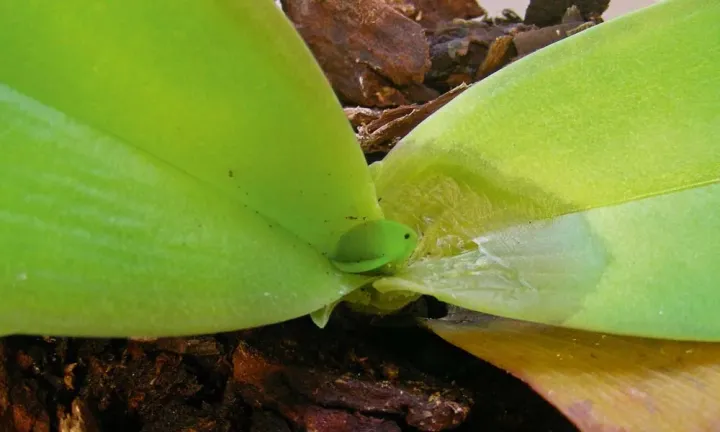
Description
Symptoms
The earliest symptom is the yellowing and wilting of the youngest leaves, known as the "spear leaf," which emerge from the center of the crown.
As the disease advances, the tissues of the apical bud (the heart of the palm) become necrotic and mushy, producing a characteristic foul, pungent odor.
Affected tissues lose their structural integrity, allowing the central leaves to be easily pulled out from the crown, revealing a mass of rotting, darkened fibers.
The rot often spreads downwards into the trunk, leading to systemic infection that severely compromises the health of the entire plant.
In the final stages, the terminal point of growth dies completely, which results in the irreversible death of the plant.
Pathogen
The causal agent of bacterial bud rot is a bacterium belonging to the genus Erwinia (often Erwinia chrysanthemi or related species), a member of the Pectobacteriaceae family.
These bacteria are gram-negative, rod-shaped pathogens characterized by the secretion of pectinolytic enzymes that degrade the middle lamella of plant cell walls.
The pathogen is an opportunistic parasite that can persist in plant debris, contaminated soil, or within the vascular tissues of infected host plants for long periods.
Infection is typically transmitted through natural openings, such as leaf axils, or via mechanical wounds created by insects, pruning tools, or environmental stress.
This pathogen has a broad host range and is particularly devastating to monocots, including the coconut palm, where it attacks the sensitive apical meristem.
Conditions for development
Bacterial bud rot is highly favored by environments with high relative humidity and frequent rainfall, which facilitate the movement of bacteria into plant tissues.
Warm temperatures, generally ranging from 25°C to 30°C, provide the ideal physiological conditions for rapid bacterial replication and colonization.
Water pooling in the leaf axils of palms creates an excellent incubator for Erwinia, allowing the bacteria to multiply and penetrate the soft meristematic tissue.
High planting density reduces air circulation, maintaining a humid microclimate around the crown that supports the onset of the disease.
Insects, particularly weevils, act as both mechanical carriers of the bacteria and create the wounds necessary for the pathogens to enter the inner tissues.
Why it matters
The economic impact of bacterial bud rot is severe because the apical bud is essential for the continuous growth and survival of the host plant.
For palms like the coconut tree, destruction of the apical meristem prevents any further vegetative growth, leading to 100% loss of the individual plant.
Outbreaks in nurseries can lead to the loss of entire batches of seedlings, resulting in significant financial losses for agricultural producers.
The infection can spread rapidly across a plantation, especially during the rainy season, necessitating the removal of affected trees to save neighboring ones.
Because there is no effective cure for advanced systemic infections, the disease poses a constant threat to the productivity and longevity of agricultural plantations.
Protection
Strict sanitation is the primary management strategy; infected plants must be uprooted and destroyed, preferably by burning, to eliminate the inoculum source.
All agricultural tools used in pruning or harvesting must be thoroughly disinfected with bleach or alcohol to prevent the cross-contamination of healthy plants.
Integrated pest management (IPM) is essential to control insect vectors that cause wounds and transport the bacteria between plants.
Protective application of copper-based bactericides can be used on wounded areas, such as pruning sites, to reduce the risk of secondary infections.
- Ensuring adequate spacing between plants to improve airflow.
- Monitoring crown health during periods of high humidity.
- Improving drainage to minimize waterlogging around root systems.
- Avoiding mechanical damage to the apical zone during cultural operations.
Pathogens and affected parts
Affects crops · 1
Discussion
No discussions yet — be the first.