
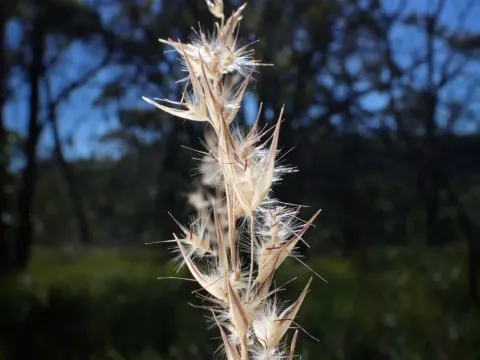
Notodanthonia
Notodanthonia
Sowing Notodanthonia is typically performed during autumn or early spring when soil moisture levels are optimal for seed germination.
What the section contains
Notodanthonia
For successful establishment, seeds should be sown at a shallow depth of 1–2 centimeters, ensuring firm contact with the soil surface.
Row planting with spacing of 15–20 centimeters is recommended to provide each plant with adequate space for nutrient uptake and growth.
Since the seedlings develop relatively slowly, it is essential to manage weed pressure early to prevent competition for resources.
Determining the seeding rate based on seed quality and the intended use of the grassland ensures a uniform and productive stand.
Notodanthonia belongs to the Poaceae family and is recognized as a hardy perennial species capable of adapting to diverse environmental conditions.
It performs best in well-drained loamy or sandy soils, demonstrating significant plasticity across various soil textures and pH levels.
A key characteristic of this grass is its remarkable drought tolerance, making it an excellent choice for regions with erratic rainfall patterns.
While Notodanthonia prefers sunny locations, it exhibits high tolerance for partial shading, maintaining its vigor under various landscape conditions.
Its inherent cold resistance makes it a suitable candidate for permanent pastures in a wide range of climatic zones.
The primary agricultural use of Notodanthonia is for grazing, as it withstands frequent and intensive traffic by livestock exceptionally well.
The forage provides high nutritional value and remains palatable to grazing animals even during dry spells when other grasses become dormant.
Productivity is closely linked to grazing management practices, with the plant showing a robust ability to regenerate after being grazed down.
The extensive root system helps form a dense sod that protects the soil surface from erosion and compaction in active pasture systems.
Beyond its value as a feed source, the grass is utilized for slope stabilization and land restoration projects due to its persistent growth habit.
The primary health concerns for Notodanthonia include fungal pathogens such as rusts and leaf spot diseases, which typically occur under high humidity.
Common cereal pests, including aphids and leaf beetles, may occasionally damage seedlings during the peak of the growing season.
Maintaining proper grazing rotation and avoiding overstocking are critical strategies for minimizing pest outbreaks and disease spread.
Targeted nitrogen fertilization helps boost plant recovery after grazing and strengthens the grass stand against common abiotic and biotic stresses.
Regular field scouting allows farmers to identify early signs of pathogen infestation and apply mitigation measures effectively.
Controlled grazing remains the most efficient method for harvesting Notodanthonia, as it stimulates tillering and continued vegetative growth.
For seed production, harvesting is performed at full maturity when the seed heads develop a characteristic golden hue and reach peak viability.
Care should be taken during mechanical harvest to avoid damage to the base of the plants, ensuring long-term persistence of the grass stand.
Following seed collection, the remaining vegetative biomass can be utilized for late-season forage or left on-site to improve soil organic matter.
Adopting sustainable grazing pressure is vital to preserve the root system and ensure consistent yields of forage over multiple years.