
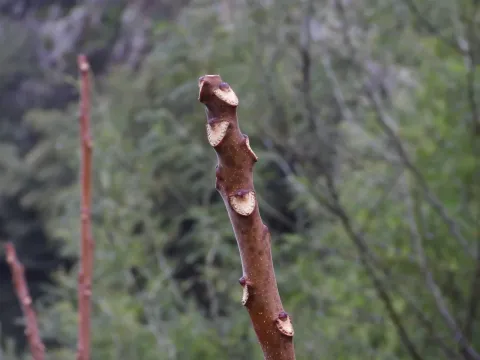
Tree of heaven
Ailanthus
Propagation of the tree of heaven (Ailanthus altissima) occurs through seeds or vegetative methods using root suckers. Sowing is typically performed in autumn or spring after cold stratification.
What the section contains

Tree of heaven
When sown in nurseries, seeds are planted at a depth of 2–3 cm in well-tilled soil. The species is noted for its extremely high germination vigor and rapid colonization ability.
In natural conditions, self-seeding occurs massively as winged seeds are dispersed by wind over long distances. For intentional cultivation, it is recommended to manage the perimeter to prevent invasive spread.
Vegetative propagation via root suckers is highly active, particularly if the parent root system is disturbed, allowing for rapid establishment of windbreaks.
The species requires minimal agronomic intervention due to its capacity for aggressive natural regeneration under favorable conditions.
Ailanthus altissima belongs to the Simaroubaceae family and is an extremely resilient species. It successfully grows in poor, rocky, and saline soils.
The plant demonstrates exceptional tolerance to drought and air pollution, making it highly suitable for urban and industrial landscaping.
It prefers sunny locations, as it is a sun-loving species. In shaded areas, trees grow slower and lose the density of their canopy.
The tree adapts easily to various climatic conditions, although young shoots may be susceptible to severe frost during their first years of life.
The species effectively stabilizes eroding slopes through its powerful and branched root system, playing a significant role in soil conservation.
The economic use of the tree of heaven in agriculture and forestry is focused on biomass production and soil erosion control on vulnerable sites.
Its timber is utilized in the furniture industry, as well as for paper and pulp production due to the rapid growth rates of the biomass.
Leaves of the plant are used in the production of technical dyes and as a feed source for silkworms in specific regions.
Growth rates are among the highest for deciduous trees in temperate zones, allowing for short-rotation forestry and quick harvesting cycles.
In agroforestry, it is often employed as a fast-growing species to establish effective windbreak barriers in arid agricultural landscapes.
The tree of heaven is classified as an aggressive invasive species capable of outcompeting native flora. This represents the primary biological threat to its management.
Major pests include the spotted lanternfly (Lycorma delicatula), which causes significant damage to both the tree itself and neighboring agricultural crops.
The tree is susceptible to fungal diseases such as Verticillium wilt, which infects the vascular system and often results in tree death.
Wood decay can occur when the bark is damaged, allowing pathogenic spores to penetrate the trunk and trigger internal rotting processes.
Control of over-proliferation requires integrated management strategies, including the use of herbicides and mechanical removal of root systems.