
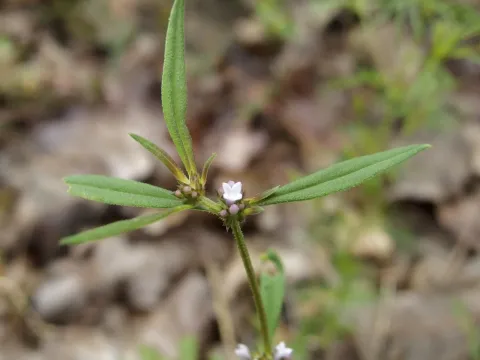
Spermacoce confusa
Spermacoce confusa
Spermacoce confusa is a perennial herbaceous plant belonging to the Rubiaceae family. It is widely recognized in agricultural sectors of tropical regions as a resilient weed that competes aggressively with various commercial crops for space and nutrients.
What the section contains
Spermacoce confusa
The plant thrives in well-lit environments and requires consistent moisture to sustain its rapid growth rate. It is highly versatile regarding soil composition, successfully establishing itself in substrates ranging from nutrient-poor sandy soils to structured loams.
Thermal requirements for optimal development range between +22 and +30 degrees Celsius. Exposure to frost is detrimental, as the species lacks the biological mechanisms necessary to survive freezing temperatures, limiting its distribution to warmer climates.
Botanically, it features characteristic opposite leaves and dense clusters of small white flowers. The root system is deep and complex, allowing the plant to recover quickly from superficial mechanical damage, which complicates manual weeding efforts.
While often viewed as a nuisance, the species is studied by agronomists to understand its invasive patterns. Effective management is crucial for maintaining yields in crops like soybeans, maize, and rice in regions where this weed is prevalent.
The plant is susceptible to various fungal pathogens that thrive in humid tropical conditions. Leaf spot diseases and powdery mildew are the most common infections that can impact the overall health of dense patches of this species.
Pest pressure often includes aphids and various sap-sucking insects that target the soft tissues of the plant. While these pests may reduce plant vigor, they are rarely sufficient to control the population without human intervention.
Integrated weed management remains the most effective strategy. This involves a combination of pre-emergent herbicide application and post-emergent mechanical cultivation to disrupt the root system before the flowering stage.
Strategic crop rotation is highly recommended to break the lifecycle of the weed, as different cultivation practices can suppress its emergence during critical stages of crop growth.
Field monitoring is essential to ensure that preventative measures are applied before the seed bank in the soil increases to unsustainable levels, which could lead to long-term infestation problems.