
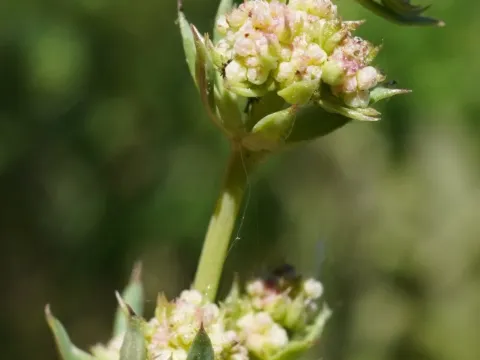
Blue Bedstraw
Galium glaucum
Blue Bedstraw (Galium glaucum) is a herbaceous perennial plant belonging to the Rubiaceae family. It is distinct for its glaucous (bluish-grey) foliage and delicate clusters of small flowers. This species is native to calcareous grasslands and rocky slopes across Europe and Asia, which explains its preference for specialized habitat conditions that mimic these natural environments.
What the section contains
Blue Bedstraw
The plant thrives in well-drained, alkaline, or limestone-rich soils. It possesses a deep-reaching root system that allows it to survive in arid environments, making it highly drought-tolerant. In agricultural settings, it is essential to ensure that the site is not prone to waterlogging, as the root zone is susceptible to decay when exposed to stagnant water for extended periods.
Climatically, Blue Bedstraw requires full sun exposure to maintain its characteristic coloration and chemical profile. It is well-adapted to high temperature fluctuations and exhibits excellent winter hardiness. In regions with significant seasonal variations, the plant remains dormant during winter and resumes growth as soon as the soil temperatures consistently exceed the early spring minimums.
Cultivation practices involve site preparation that focuses on improving drainage and clearing competing weeds. Due to the slow development of seedlings, regular inter-row cultivation is highly recommended during the first year of growth. Once established, the plant becomes quite competitive and requires minimal intervention, provided the environmental conditions remain stable and favorable for its physiological needs.
Economically, Blue Bedstraw is valued in the pharmaceutical industry for its unique secondary metabolites. The plant has a history of use in traditional medicine, particularly for its soothing and diuretic properties. Furthermore, due to its ability to grow in nutrient-poor and rocky soil, it serves as an excellent candidate for landscape restoration and stabilizing slopes to prevent soil erosion.
The primary threats to healthy crop stands include fungal diseases such as powdery mildew, which thrive in stagnant, humid air environments. Root rot can also become a limiting factor if the soil pH drops significantly or if drainage fails. Integrated pest management, focusing on proper air circulation and density control, is the most effective way to prevent these issues without heavy chemical use.