
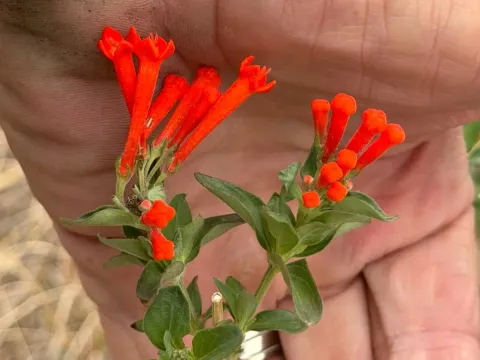
Bouvardia
Bouvardia Salisb.
In commercial cultivation, Bouvardia is typically propagated by cuttings, which are taken during the spring season, specifically from February to April. Utilizing terminal cuttings measuring 10-15 cm ensures high-quality plant material with a well-developed root system.
What the section contains
 Bouvardia
 longiflora x Bouvardia ternifolia
Bouvardia
Bouvardia longiflora x Bouvardia ternifolia
 Bouvardia glaberrima
 Engelm.
Bouvardia longiflora
Bouvardia longiflora (Cav.) Kunth
Bouvardia glaberrima
Bouvardia glaberrima Engelm.
Bouvardia longiflora
Bouvardia longiflora (Cav.) Kunth
 Bouvardia multiflora
 (Cav.) Schult. & Schult. f.
Bouvardia multiflora
Bouvardia multiflora (Cav.) Schult. & Schult. f.
 Bouvardia triphylla
 Salisb.
Firebush (Bouvardia ternifolia)
Bouvardia ternifolia (Cav.) Schltdl.
Bouvardia triphylla
Bouvardia triphylla Salisb.
Firebush (Bouvardia ternifolia)
Bouvardia ternifolia (Cav.) Schltdl.
Bouvardia
For successful rooting, it is essential to maintain a stable substrate temperature within the range of 20-22 degrees Celsius. The application of phytohormones accelerates the root formation process and significantly increases the survival rate of young plants in nursery containers.
Seed sowing is used less frequently, as varietal characteristics may be lost through this method. If sowing is practiced, it should be done in a light, sterile substrate in late winter under a plastic cover to create a greenhouse effect.
Once two pairs of true leaves emerge, seedlings are transplanted into individual pots. Providing sufficient lighting is crucial, as light deficiency in the early stages leads to leggy stems and weakens the overall structure of the plant.
To promote the formation of a bushy habit, plants are pinched regularly. This agronomic technique stimulates the development of lateral branches, which directly affects the volume of future flowering and the plant's overall decorative value.
Bouvardia, belonging to the Rubiaceae family, is a tropical perennial, which dictates its high temperature requirements. During the active growth phase, the optimal temperature range is between 18 and 25 degrees Celsius.
The plant is highly sensitive to light intensity and prefers bright but indirect sunlight. Direct noon sun can cause leaf scorch; therefore, commercial greenhouses often use shading or supplementary phytolamps to ensure consistent light levels.
The soil mixture for Bouvardia must be loose, well-aerated, and slightly acidic. An optimal composition includes turf soil, peat, and sand in a 2:1:1 ratio, ensuring proper drainage and preventing moisture stagnation.
The crop requires regular but moderate watering. Over-saturation of the soil is detrimental to the root system and frequently leads to root rot, making it vital to monitor substrate moisture and ensure an effective drainage layer.
Humidity plays a critical role in the plant's health; Bouvardia prefers levels no lower than 60-70 percent. In dry environments or during intensive heating seasons, regular misting or the use of humidifiers is necessary.
The commercial use of Bouvardia is primarily focused on cut flower production or as a potted ornamental crop. The plant's productivity is directly dependent on adhering to pruning schedules after each flowering wave.
With proper agronomy, a single plant can produce multiple flowering cycles per year. Bouvardia inflorescences are highly valued for their exquisite fragrance and longevity in floral arrangements, making them popular for weddings and special occasions.
To achieve maximum marketable output, plants are regularly fed with complex mineral fertilizers, with a focus on potassium and phosphorus. Nitrogen fertilizers are used early in the growth stage to stimulate foliage development.
A key factor in yield is the management of unwanted stem elongation. The use of plant growth regulators helps produce compact, well-foliaged plants with a large number of buds that are ready to bloom simultaneously.
The total yield also depends on the age of the plant. Specimens aged 1-2 years are the most productive; beyond this, decorative quality may decline, necessitating crop renewal or rejuvenating pruning practices.
The primary pests causing significant damage to Bouvardia crops include aphids, spider mites, and whiteflies. These insects feed on cell sap, leading to leaf deformation and the premature dropping of buds.
Pest prevention includes regular monitoring of plant health and maintaining an optimal microclimate. If outbreaks are detected, systemic insecticides and acaricides are applied to control the infestation.
Among diseases, fungal infections such as powdery mildew and grey mold are the most dangerous. Pathogen development is favored by high humidity combined with poor ventilation and sudden temperature fluctuations.
Root rots (Pythium, Rhizoctonia) often occur when watering schedules are neglected or non-sterile substrates are used. Soil-borne infections are treated with targeted fungicides at the first sign of damage.
- Preventive fungicide treatment in early spring.
- Maintaining proper spacing to ensure adequate air circulation.
- Regular removal of plant debris and dead foliage.