
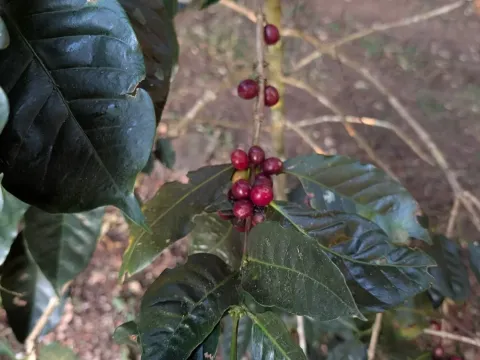
Coffee
Coffea
Coffee cultivation begins with the selection of high-quality seeds, which maintain viability for a relatively short period, typically around six months post-harvest. Proper seed preparation is critical to ensure high germination rates.
What the section contains


Coffee
Seeds are sown in prepared nursery beds or individual containers filled with well-drained, nutrient-rich soil. They are usually planted at a depth of 1–2 cm, placed flat-side down to facilitate consistent sprouting.
Maintaining a temperature range of 20–25 degrees Celsius is essential for successful germination. The substrate must be kept consistently moist but not waterlogged, as excessive moisture can easily lead to damping-off diseases.
Once the seedlings develop their first set of true leaves, they are transplanted into larger containers to allow for root development. In the nursery, they are raised for 6 to 12 months until they reach a height of 30–50 cm.
Planting density is determined by the specific variety and terrain steepness. On plantations, densities usually range from 2,000 to 3,500 trees per hectare, ensuring that each tree has sufficient space for air circulation and sunlight exposure.
Coffee is an evergreen shrub belonging to the Rubiaceae family. It thrives in tropical climates, generally requiring stable temperatures between 18 and 24 degrees Celsius throughout the year for optimal metabolism.
Annual rainfall of 1,500 to 2,500 mm is ideal, provided it is well-distributed. Coffee trees require a distinct dry season to stimulate flowering, followed by a wet season to support the growth and maturation of the berries.
The ideal soil for coffee is deep, fertile, and well-drained. Volcanic soils rich in organic matter are preferred, typically maintaining a slightly acidic pH level between 5.0 and 6.0 for maximum nutrient uptake.
Young coffee trees are sensitive to intense direct sunlight and often require shade trees to protect them during their early stages of growth. In high-altitude regions, natural cloud cover often provides sufficient protection against heat stress.
Routine pruning is a fundamental agronomic practice. It helps maintain a manageable tree height, promotes the growth of new productive branches, and significantly improves airflow, which reduces the incidence of fungal diseases.
Coffee trees typically begin to produce their first harvest 3 to 5 years after being transplanted to the field. Peak productivity is generally reached between the ages of 7 and 8, continuing for several decades under good care.
Yield varies based on the botanical species, such as Coffea arabica or Coffea canephora (Robusta), as well as soil quality and management practices. An average mature tree can produce 0.5 to 2 kg of green coffee beans per season.
The ripening of coffee cherries is often staggered, requiring selective harvesting. High-quality production depends on the ability to pick only fully mature cherries, which requires multiple passes through the plantation.
Intensive farming practices, including the precise application of NPK fertilizers, allow farmers to significantly improve their output. Balanced nutrition is vital for supporting heavy fruit loads and ensuring long-term tree health.
After harvesting, the cherries undergo processing—either wet or dry methods—to separate the beans from the pulp. The beans are then fermented, washed, and dried to a moisture content of roughly 10–12 percent for storage.
Coffee Leaf Rust (Hemileia vastatrix) is the most significant fungal disease, causing widespread leaf loss and reduced yields. Resistant varieties and rigorous monitoring are the primary methods for managing this threat.
The coffee berry borer (Hypothenemus hampei) is a devastating pest that bores into the fruit to lay eggs. Damage to the seeds renders the coffee beans commercially worthless, making pest control a top priority for farmers.
Scale insects and mealybugs also pose a threat by feeding on plant sap and weakening the trees. These pests can produce honeydew, which leads to the growth of sooty mold, further interfering with photosynthesis.
Integrated Pest Management (IPM) is essential for coffee farms, combining mechanical practices like pruning, biological controls using natural predators, and the careful use of chemical interventions only when necessary.
- Enforcing strict quarantine on imported planting material.
- Utilizing rust-resistant coffee hybrids.
- Managing canopy cover to prevent excessive humidity.
- Deploying pheromone traps to monitor pest populations.
Harvesting is one of the most labor-intensive aspects of coffee production. Success depends on the skill of the pickers, who must distinguish between various stages of ripeness based on cherry color.
Selective hand-picking is the gold standard for quality. Pickers repeatedly revisit the same trees over several weeks, harvesting only the cherries that have reached the perfect state of maturity.
Mechanical stripping involves removing all cherries from a branch in a single motion. While faster, this method is less precise and is generally reserved for lower-grade coffees or specific terrain conditions.
In many mountainous regions, hand-picking is the only viable method due to the rugged topography. This high dependence on manual labor is a major factor in the overall cost of premium coffee production.
Post-harvest logistics are time-sensitive. The cherries must be processed promptly—ideally within hours of harvest—to prevent unwanted fermentation and spoilage, which would otherwise ruin the delicate flavors of the coffee.