
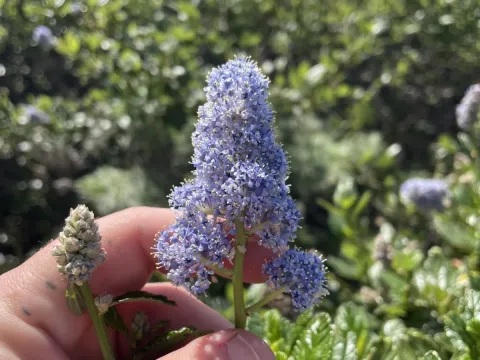
Ceanothus
Ceanothus L.
Ceanothus, commonly known as California lilac, belongs to the family Rhamnaceae. This genus comprises a diverse group of evergreen and deciduous shrubs and small trees native primarily to North America, celebrated for their spectacular clusters of blue, purple, or white flowers.
What the section contains
 Carmel ceanothus
Ceanothus griseus (Trel.) McMinn
Carmel ceanothus
Ceanothus griseus (Trel.) McMinn
 Ceanothus americanus
 L.
Ceanothus americanus
Ceanothus americanus L.
 Ceanothus dentatus
 Torr. & A. Gray
Ceanothus dentatus
Ceanothus dentatus Torr. & A. Gray
 Ceanothus impressus
 Trel.
Ceanothus impressus
Ceanothus impressus Trel.
 Ceanothus thyrsiflorus
 Eschsch.
Ceanothus thyrsiflorus
Ceanothus thyrsiflorus Eschsch.
 Ceanothus x delileanus
 Spach
Ceanothus x delileanus
Ceanothus x delileanus Spach
 Hybrid Ceanothus
Ceanothus gloriosus J. T. Howell x Ceanothus impressus Trel.
Hybrid Ceanothus
Ceanothus gloriosus J. T. Howell x Ceanothus impressus Trel.
 Pale ceanothus
Ceanothus x pallidus Lindl.
Point Reyes ceanothus
Ceanothus gloriosus J. T. Howell
Pale ceanothus
Ceanothus x pallidus Lindl.
Point Reyes ceanothus
Ceanothus gloriosus J. T. Howell
 Squawcarpet
Ceanothus prostratus Benth.
Squawcarpet
Ceanothus prostratus Benth.
Ceanothus
The cultural success of Ceanothus depends heavily on location; these plants require a position in full sun with excellent air circulation. The soil must be well-drained and neutral to slightly acidic, as the plant is highly susceptible to root rot in waterlogged or heavy clay conditions.
Climate requirements vary by species, but most Ceanothus varieties thrive in Mediterranean-like climates with mild, wet winters and dry summers. In regions experiencing harsh winters, they require protection or a sheltered position against a south-facing wall to prevent cold damage.
Agronomic maintenance includes minimal pruning, primarily performed after flowering to encourage dense growth and shape the plant. Irrigation should be managed carefully, especially in summer, to avoid excessive soil moisture that can compromise the plant's long-term viability.
Economically, Ceanothus is highly valued in the nursery industry and residential landscaping. Its ability to thrive in poor soils once established, combined with its nectar-rich flowers that support pollinators, makes it a staple plant for sustainable and wildlife-friendly garden designs.
The primary threats to Ceanothus health include fungal infections such as root rot and Armillaria, which are exacerbated by poor drainage or excessive summer irrigation. Preventive measures focus on site selection and ensuring the crown of the plant remains dry.
Pest pressures typically involve aphids, scale insects, and spider mites, which can weaken the shrub if left unchecked. Integrated pest management, including regular inspections and the use of horticultural oils or targeted insecticides, is recommended to keep the foliage clean and productive.