
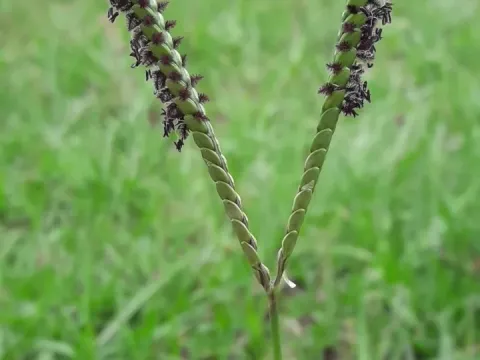
Paspalum
Paspalum
Sowing of Paspalum is ideally performed during the spring when soil temperatures reach a consistent range of 15–18 degrees Celsius. Establishing the crop during this period ensures that seedlings are protected from late frost events, which can be detrimental to the young plants.
What the section contains
 Dallis grass
Paspalum dilatatum Poir.
Dallis grass
Paspalum dilatatum Poir.
 Hilo grass
Paspalum conjugatum P. J. Bergius
Hilo grass
Paspalum conjugatum P. J. Bergius
 Knotgrass
Paspalum distichum L.
Knotgrass
Paspalum distichum L.
 Kodo millet
Paspalum scrobiculatum L.
Kodo millet
Paspalum scrobiculatum L.
 Paspalum atratum
 Swallen
Paspalum atratum
Paspalum atratum Swallen
 Paspalum fasciculatum
 Willd. ex Flüggé
Paspalum guenoarum
Paspalum guenoarum Arechav.
Paspalum fasciculatum
Paspalum fasciculatum Willd. ex Flüggé
Paspalum guenoarum
Paspalum guenoarum Arechav.
 Paspalum maritimum
 Trin.
Paspalum maritimum
Paspalum maritimum Trin.
 Paspalum nicorae
 Parodi
Paspalum nicorae
Paspalum nicorae Parodi
 Paspalum notatum
 Flüggé
Paspalum notatum
Paspalum notatum Flüggé
 Paspalum plicatulum
 Michx.
Paspalum regnellii
Paspalum regnellii Mez
Paspalum wettsteinii
Paspalum wettsteinii Hack.
Paspalum plicatulum
Paspalum plicatulum Michx.
Paspalum regnellii
Paspalum regnellii Mez
Paspalum wettsteinii
Paspalum wettsteinii Hack.
 Seashore paspalum
Paspalum vaginatum Sw.
Seashore paspalum
Paspalum vaginatum Sw.
 Vaseygrass
Paspalum urvillei Steud.
Vaseygrass
Paspalum urvillei Steud.
Paspalum
The seeds should be planted at a shallow depth of 1–2 centimeters, as they are relatively small and require proximity to the soil surface for successful germination. Following the sowing process, rolling the field is highly recommended to improve soil-to-seed contact and optimize moisture absorption.
Seeding rates typically range from 8 to 15 kilograms per hectare, depending on the desired density and the intended application, such as grazing or hay production. Precision planters help ensure uniform distribution and avoid competition between emerging seedlings.
To enhance the germination energy, seeds are often treated or soaked prior to sowing in large-scale operations. Using high-quality, certified seed stock with high germination percentages is a prerequisite for achieving a uniform and productive stand.
Post-sowing moisture management is critical for success. Providing consistent irrigation during the establishment phase encourages the development of a strong primary root system, which is vital for the plant's long-term survival and productivity.
Paspalum, a member of the Poaceae family, is recognized as a heat-loving crop of tropical and subtropical origin. It demonstrates remarkable adaptability, thriving in a wide range of soil types, including sandy, nutrient-poor soils and heavy clay substrates.
The crop is highly tolerant of temporarily waterlogged soils, making it an excellent choice for planting in low-lying areas. However, for maximum growth and biomass production, Paspalum performs best in well-drained soils with a slightly acidic to neutral pH level.
Climate is the primary driver of Paspalum growth. It demands plenty of sunlight and high temperatures to reach its potential. Growth significantly declines when temperatures drop below 10 degrees Celsius, which often limits its lifecycle in temperate climates.
Due to an extensive and deep-reaching root system, Paspalum exhibits high drought tolerance. This trait allows the plant to access moisture from deeper soil layers, enabling it to maintain green biomass even during moderate dry spells.
Fertilization is a key component of effective management, particularly the application of nitrogen after each harvest. Regular nutrient replenishment stimulates rapid regrowth and ensures that the forage remains high in nutritional quality throughout the season.
The yield potential of Paspalum is largely determined by management practices, including irrigation frequency and fertilization schedules. Under optimal conditions, the crop can yield 4–6 cuts per season, resulting in significant biomass accumulation.
Average green mass yields typically range between 30 and 50 tonnes per hectare. While hay production results in lower raw mass, the resulting forage is highly palatable and nutritionally dense, making it excellent for livestock feed programs.
Economic viability is greatly improved when the crop is utilized for intensive grazing. Its ability to recover rapidly after defoliation allows for higher stocking rates and more efficient use of land compared to less vigorous grass species.
Managing weed competition during the initial establishment phase is crucial to achieving high yields. Since Paspalum grows slowly in its first few weeks, maintaining a weed-free environment during this period is essential for future productivity.
Seed harvest, when required, should be performed at full maturity to prevent excessive shattering losses. Yields of seed are variable but generally support sustainable farm-level replanting or commercial sale.
Fungal diseases, such as rusts and various leaf spots, are the most common health challenges for Paspalum. These infections are often triggered by high humidity, necessitating the use of fungicides or improved air circulation to manage the impact.
Insects like leafhoppers and aphids are frequent pests, damaging foliage and acting as vectors for viral diseases. Regular field monitoring is necessary to detect and control these populations before they reach economic injury thresholds.
Root rot can occur in poorly drained soils or conditions of prolonged saturation, leading to stunted growth or crop loss. Proper site selection and land preparation are the most effective preventive measures against these soil-borne threats.
Weed control programs must be implemented with care, using selective herbicides that do not harm the Paspalum stand. It is important to apply these treatments at the correct growth stage to ensure maximum efficacy and minimal phytotoxicity.
Integrated Pest Management (IPM) strategies, which include cultural, mechanical, and biological controls, are recommended. This approach helps maintain a healthy crop while reducing reliance on intensive chemical applications.
Harvesting Paspalum for hay or silage should be timed to the early heading stage. At this phase, the plant offers the best balance of protein and structural fiber, ensuring high digestibility and energy value for livestock.
Cutting height should be kept at 5–7 centimeters above the soil surface. This specific height is critical because it leaves enough of the leaf base for the plant to recover and initiate rapid regrowth for the subsequent harvest cycle.
Following the harvest, the material should be wilted in the field for 1–2 days under sunny conditions. This process reduces moisture levels to an optimal range for baling or ensiling, which preserves the quality of the harvested biomass.
When used in a grazing system, rotational grazing is the preferred method to prevent overgrazing. This system allows the grass to rest and replenish its root reserves, ultimately prolonging the lifespan and productivity of the pasture.
The final harvest of the season must be completed at least 30 days before the onset of the first killing frost. This timeframe allows the plants to store adequate carbohydrates in their crowns to survive winter dormancy and thrive again in the spring.