
Hilo grass
Paspalum conjugatum P. J. Bergius
Description
Growing requirements
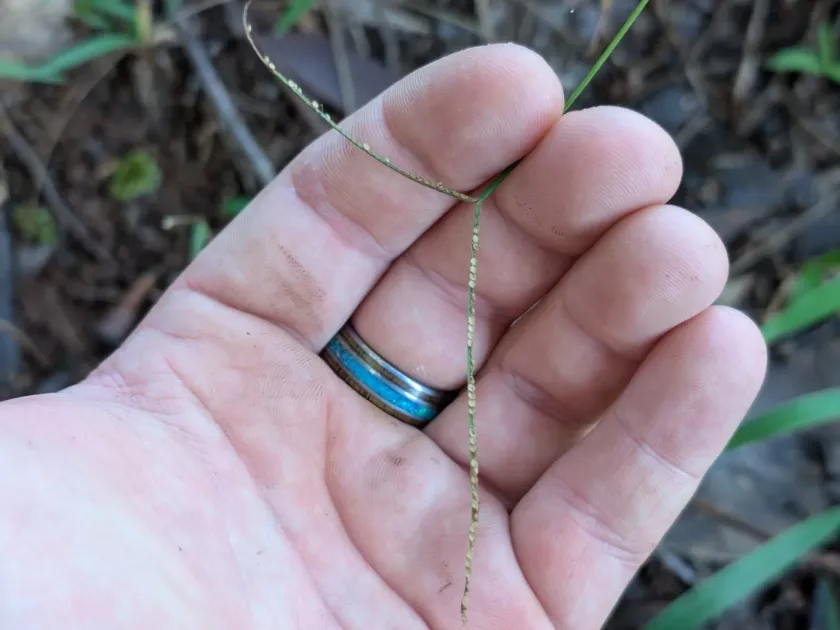
Hilo grass (Paspalum conjugatum) is a perennial stoloniferous grass species within the Poaceae family. It is recognized by its spreading habit, where trailing stems root at the nodes to form dense mats across the landscape.
Native to tropical regions of the Americas, this species has become widespread throughout the tropics and subtropics. It is often found in disturbed areas, plantation clearings, roadsides, and tropical forest margins.
The plant thrives in warm, humid climates with consistent rainfall. It is remarkably shade-tolerant compared to other pasture grasses, allowing it to persist under the canopy of plantation trees or within open forest gaps.
In terms of soil requirements, it prefers moist, fertile, and slightly acidic to neutral soils. While it shows versatility across various soil types, its performance is significantly better in areas where the soil moisture remains high.
Economically, it is utilized as ground cover to prevent erosion and as a secondary forage source for cattle. However, its low palatability compared to other grasses often limits its value as a primary fodder crop in intensive livestock systems.
Main diseases and pests
Paspalum conjugatum is susceptible to several fungal diseases, most notably leaf rusts and various leaf spots. These pathogens are most active during periods of high humidity and limited airflow within the grass mat.
Pest pressures include a variety of insects, such as grass loopers and armyworms, which can cause significant defoliation. Soil-borne pests, such as nematodes, can also impact the root system in poorly drained or waterlogged soils.
Because of its aggressive growth habit, it is frequently classified as a problematic weed in many plantation crops, including coffee, cacao, and oil palm, where it competes for nutrients and hampers plantation management.
The control of Hilo grass is typically achieved through integrated management techniques, involving repeated mowing or weeding to exhaust the stolons, combined with appropriate herbicide applications where selective control is required.
Preventative strategies focus on maintaining vigorous competing vegetation or cover crops that can outcompete the Hilo grass for light, thereby limiting its expansion into sensitive agricultural zones.