
Paspalum cromyorhizon
Paspalum cromyorhizon
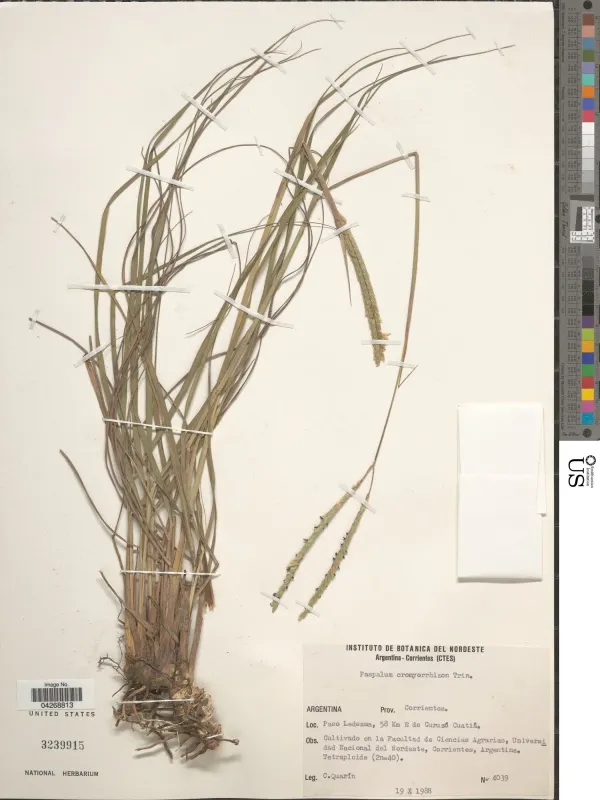
Description
Sowing dates
Sowing of Paspalum cromyorhizon should be carried out during periods of stable soil warmth to ensure quick and uniform germination of the seeds.
The seeds are relatively small, so planting at a shallow depth of 1-2 cm is crucial to allow the seedlings to emerge without exhausting their stored energy.
Rolling the field immediately after sowing is recommended to improve the seed-to-soil contact, which is vital for moisture uptake in drier climates.
In regions with distinct tropical or subtropical seasons, planting is often aligned with the onset of the wet season to optimize early growth.
It can be established through direct drilling into existing pastures or by preparing a clean seedbed to minimize competition from broadleaf weeds.
Growing requirements
Paspalum cromyorhizon belongs to the Poaceae family and is well-known for its robust root system, which includes bulbous structures that store nutrients.
The species thrives in sunny environments and is adaptable to a wide range of soil types, including those with poor drainage, although it performs best in fertile, well-drained soils.
Climate-wise, it prefers warm to hot growing conditions, making it an excellent candidate for agricultural zones in the tropics and subtropics.
It displays remarkable resilience to dry spells due to its physiological adaptations, allowing the plant to remain dormant and recover quickly when moisture returns.
To maximize forage production, moderate applications of nitrogen-based fertilizers are recommended to boost leaf growth and improve the protein content of the fodder.
Yield
The biomass yield of this crop is highly dependent on management practices such as rotation grazing and the frequency of fertilizer application.
Under optimal conditions, the plant produces a dense canopy of foliage that is highly palatable to livestock, making it a valuable resource for grazing systems.
Regrowth rates are typically rapid if the plant is not overgrazed, ensuring a consistent supply of quality forage throughout the primary growing season.
Research indicates that yield potential increases significantly in areas with well-distributed rainfall and high light intensity throughout the day.
For best results, it is suggested to allow a recovery period after harvesting or heavy grazing to ensure the root reserves are replenished.
Main diseases and pests
Common diseases affecting this species include various forms of rust and leaf spots which can reduce the photosynthetic efficiency of the plant.
Insect pests, specifically caterpillars and grasshoppers, can cause significant damage to the leaf tissue, leading to a drop in total forage output.
Integrated pest management, including monitoring and avoiding overstocking, helps maintain the health of the Paspalum stand.
Fungal infections can become more prevalent during extended periods of high humidity and rainfall, necessitating careful management of stand density.
Good agricultural practices, such as balanced fertilization and proper pasture rotation, are the best defenses against most environmental and biotic stressors.