
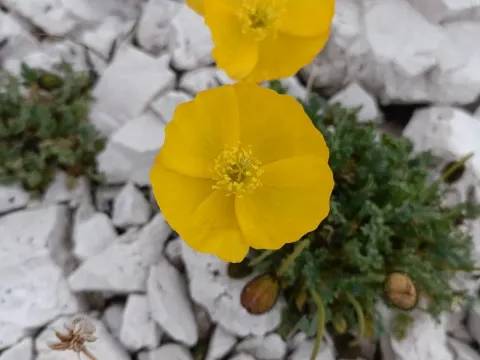
Western poppy
Papaver occidentale
Western poppy (Papaver occidentale) is a perennial herbaceous plant belonging to the Papaveraceae family. It is primarily known as an endemic species native to the rocky slopes and subalpine regions of the western mountain ranges.
What the section contains
Western poppy
The plant exhibits specific botanical traits, including finely dissected leaves and delicate petals that are adapted to withstand high-altitude wind currents. Its root system is deep and taproot-like, allowing the plant to anchor securely in unstable scree slopes.
In terms of climatic requirements, this species thrives in environments with cool summers and significant diurnal temperature variations. It does not tolerate high humidity levels combined with stagnant heat, which often leads to physiological stress.
Soil composition is a critical factor for success; the substrate must be well-drained, lean, and mineral-rich. Attempting to grow it in fertile garden soil often results in reduced vigor and susceptibility to environmental stressors.
The primary use of Western poppy is in specialized ornamental horticulture and botanical conservation, where it is prized for its rarity and its unique appearance compared to common field poppies.
The most significant threats to Western poppy health are fungal infections, particularly those affecting the root collar, which are exacerbated by poorly drained growing mediums.
Aphids are the most common insect pests, frequently targeting the tender developing buds. If left untreated, severe infestations can significantly reduce seed production.
Environmental factors, such as winter crown rot caused by prolonged moisture contact during dormancy, can be lethal to older specimens.
Weed management is essential, as the species is not competitive and will quickly succumb to encroaching grasses or faster-growing perennials.
Cultural control measures, such as providing a gravel mulch around the base of the plant, are highly recommended to keep the foliage dry and prevent soil-borne pathogens.